


6 min read time

Table of Contents

When Does a Car Accident Become a Criminal Offense?
Most car accidents are treated as civil matters, but specific circumstances can push a crash into a criminal charge. A standard fender-bender caused by simple negligence, such as distracted driving, rarely turns into a criminal charge, yet the same accident can become a criminal offense when certain aggravating factors are present, such as:
- Drunk driving with a blood alcohol concentration above the legal limit of 0.08%
- Excessive speeding well beyond the posted speed limit
- Reckless driving that shows willful disregard for human life
- Impaired driving due to controlled substances
- Fleeing the scene after causing serious bodily injury
Under criminal law, prosecutors must prove that a driver's conduct went beyond an honest mistake. Fatal car accidents involving any of these behaviors can result in felony charges, including vehicular manslaughter.
Also, even if you're not at-fault for a car accident, you can still be charged criminally if you were committing a crime at the time of the accident, for example, driving under the influence.
The Difference Between Civil Liability and Criminal Charges in Car Accidents
Civil liability centers on compensating victims for personal injury or property damage through insurance company settlements or lawsuits. Criminal charges, by contrast, serve punishment via mandatory jail time or fines. Key distinctions include:
- Intent or gross negligence
- Reckless behavior beyond ordinary mistakes
Both civil liability and criminal punishment can arise from one crash simultaneously. For example, if driver A is hit by driver B who was involved in a street race, driver A can pursue a civil lawsuit and a criminal reckless driving charge against driver B.
The Role of Intent and Negligence in Criminal Charges
In criminal law, intent and negligence serve as the dividing line between a mistake and a crime. Reckless driving, for instance, doesn't require intent to harm, but involves conscious disregard for safety, which courts treat far more seriously than careless driving.
This distinction can determine whether a driver faces criminal charges.
How Severity of the Accident Influences Criminal Prosecution
Accident severity directly shapes whether prosecutors pursue criminal charges. Cases involving:
- Fatalities
- Serious injury
- Multiple victims
...face charges at felony levels, while crashes with minor injuries typically remain civil matters or at most misdemeanors. A fatal accident caused by reckless driving can trigger vehicular manslaughter charges carrying up to 15 years imprisonment.
Criminal Charges That Can Result From Causing a Car Accident
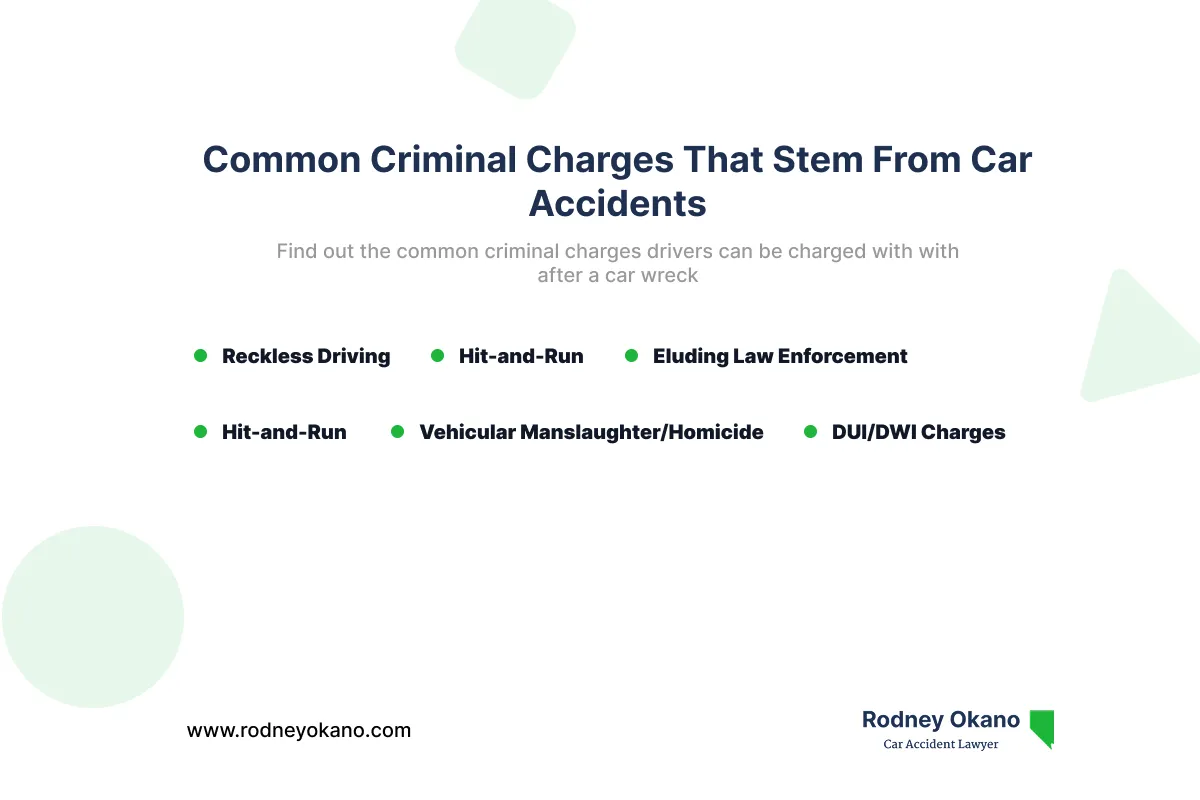
Causing a car accident can expose a driver to several specific criminal charges, each carrying distinct punishments. Depending on the circumstances, a driver may face:
- DUI charges, which can range from a misdemeanor to a felony based on injury severity
- Vehicular manslaughter, triggered when negligent or reckless driving causes a death
- Vehicular homicide, which applies when prosecutors can demonstrate a higher degree of recklessness or intent, but doesn't require intent to kill
- Reckless driving, often charged when a driver consciously disregards traffic laws
These charges carry criminal penalties including mandatory jail time, heavy fines, and a permanent criminal record. A DUI conviction alone can result in up to four years in state prison, depending on prior offenses and whether the accident caused serious bodily harm.
Hit-and-Run: Leaving the Scene of an Accident
Fleeing an accident scene results in immediate criminal charges, separate from the underlying crash. Penalties escalate based on:
- Property Damage Only: misdemeanor charge
- Injury Involved: felony charge
- Fatal Hit-and-Run: up to 20 years imprisonment
Law enforcement treats leaving the scene as consciousness of guilt, severely impacting any related criminal case and civil claim.
Driving Under the Influence (DUI) or Driving While Intoxicated (DWI)
Operating a vehicle with a blood alcohol concentration (BAC) of 0.08% or higher is a per se DUI violation in most states, including Nevada, meaning no additional proof of impairment is needed.
Being convicted of criminal charges under DUI/DWI laws can result in:
- License suspension
- Required DUI school
- Fines
- Mandatory ignition interlock installation
A BAC of 0.15%-0.18% or higher typically triggers aggravated DUI charges, carrying more severe punishments.
Reckless Driving and Criminal Negligence
Reckless driving, broadly defined as willful disregard for others' safety, carries severe penalties including up to 90 days in jail for misdemeanors. Behaviors considered reckless driving include:
- Excessive speeding
- Running red lights
- Street racing
- Evading police
- Unsafe lane changes
Vehicular Manslaughter and Vehicular Homicide
Vehicular manslaughter charges arise when a driver's negligence directly causes another person's death. The potential penalties vary by degree:
- Misdemeanor vehicular manslaughter carries up to 1 year in jail
- Felony vehicular manslaughter, which involves gross negligence, ranges from 2 to 20 years in prison
Vehicular homicide differs by requiring proof of conscious indifference to human life, but does not require an intent to kill.
Eluding Law Enforcement After a Crash
After a car crash, if a driver evades police, they can face charges for evading police, which can result in varying criminal punishments depending on severity:
- Evading Police on Foot: Up to 1 year in jail
- Evading Police in a Vehicle (No Injury, Short Pursuit): Up to 1 year in jail
- Evading Police in a Vehicle (Pursuit involving reckless behavior): Felony with up to 5 years in prison
- Evading Police in a Vehicle (Pursuit involving injury or death): Felony with up to 20 years in prison
Misdemeanor vs. Felony Charges After a Car Accident
The line between a misdemeanor and felony charge after a car accident often comes down to specific factors like injury severity, prior criminal history, and the driver's conduct at the time of the crash.
A misdemeanor reckless driving charge, for instance, typically applies when no serious bodily harm occurred, carrying penalties like fines or up to 90 days in jail, and could be dismissed through community service or traffic school.
Felony charges emerge when the severity of the crash increases, such as when a motor vehicle collision results in permanent disability or death. Prior DUI convictions, often two or more, can automatically elevate a new charge from misdemeanor to felony status, increasing sentencing from months to multiple years in prison.
What Qualifies as a Misdemeanor Charge in a Car Accident Case
Misdemeanor charges in auto accidents commonly arise when property damage is minor, or injuries are non-serious. Qualifying scenarios typically include:
- Reckless driving causing a fenderbender
- First-offense DUI with no injuries
- Minor hit-and-run involving only property damage
These charges carry potential consequences such as fines up to $1,000 and suspension of driving privileges, but stop short of felony-level imprisonment thresholds.
What Qualifies as a Felony Charge in a Car Accident Case
Felony charges in a car accident case typically arise when the incident involves serious bodily injury, death, or aggravated circumstances like driving under the influence. Reckless driving that led to catastrophic harm, such as a collision causing traumatic brain injuries or fatalities, elevates charges to felony status.
Specific qualifying factors include:
- Prior DUI convictions
- A BAC significantly above the legal 0.08% threshold
- Hit-and-run after a serious or fatal car accident
Frequently Asked Questions About Going to Jail for Causing a Car Accident
Can You Go to Jail for Accidentally Causing a Car Accident?
Accidentally causing a car accident typically does not result in jail time. Criminal charges generally require proof of negligence, recklessness, or intent.
However, if gross negligence or impairment is involved, you could be facing criminal charges. Simple mistakes, like misjudging distance, are usually handled through civil liability rather than criminal prosecution.
What Is the Difference Between Vehicular Manslaughter and Vehicular Homicide?
Vehicular manslaughter typically involves negligent or reckless driving that causes death, often charged as a misdemeanor or felony depending on circumstances. Vehicular homicide generally implies a more intentional disregard for human life, carrying felony charges and enhanced penalties.
While definitions vary by jurisdiction, vehicular homicide commonly results in felony charges, with potential sentences exceeding 15 years in serious cases.
How Long Can You Go to Jail for a Hit-and-Run?
Jail time for a hit-and-run varies by severity. A misdemeanor hit-and-run involving property damage can result in up to one year in county jail. A felony hit-and-run involving injury or death can carry up to 20 years in state prison. Penalties increase significantly if serious bodily injury or fatalities are involved.
Can You Face Criminal Charges and Civil Liability
Yes, you can face both criminal and civil liability for the same act. The Double Jeopardy Clause only prevents being tried twice criminally for the same offense, not civil proceedings.
Criminal cases require proof "beyond a reasonable doubt," while civil cases use a lower "preponderance of evidence" standard, meaning different outcomes in each case are possible.
Obtain the Compensation You're Entitled To
Contact Us Today
The Rodney Okano Car Accident Lawyer Law Firm is a Las Vegas personal injury law firm that specializes in representing those in car, truck, bus, and motorcycle accidents. Founded in 2001, our law firm has over 20 years of legal experience in Nevada and has remained dedicated to securing the maximum settlement for those injured in motor vehicle accidents. Our firm offers free consultations, which can be set up by calling or sending an email inquiry.