


7 min read time

Table of Contents

5 Ways You Can Get Video Footage of Your Car Accident in Las Vegas
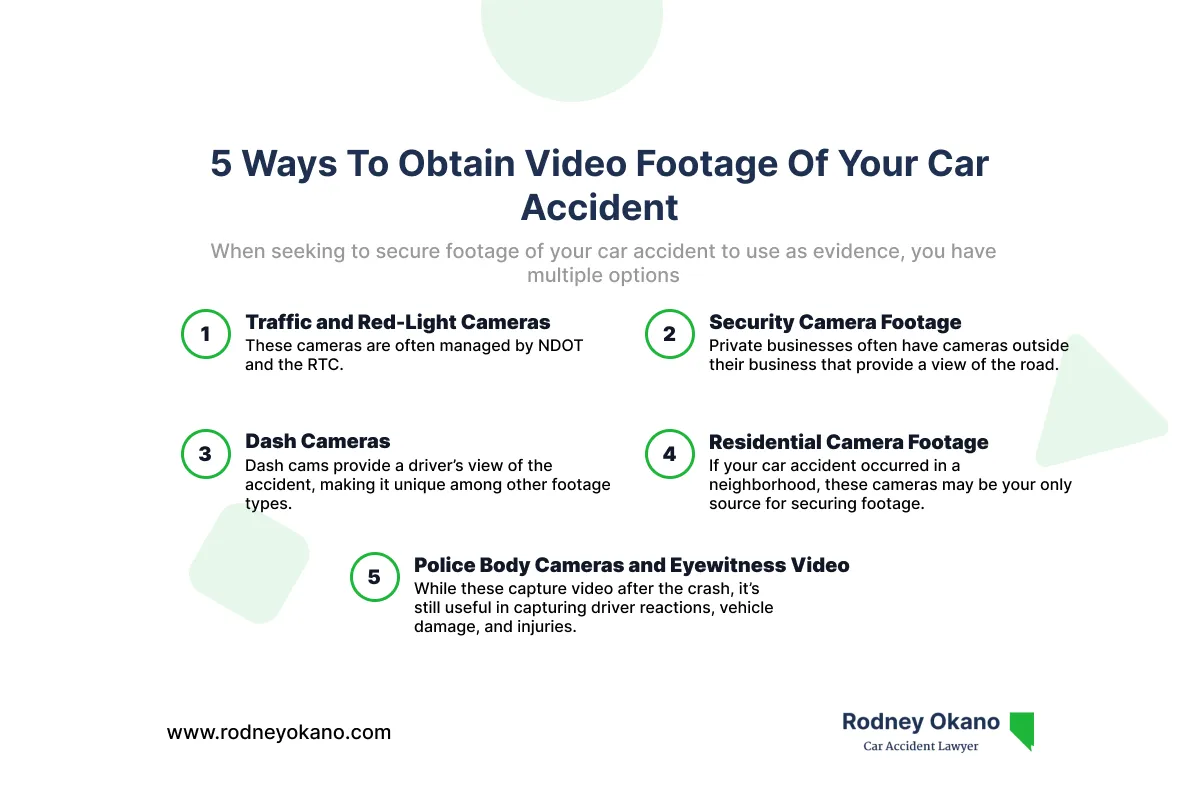
Multiple types of video footage can serve as evidence in your Las Vegas car accident case, each capturing different angles and details of how the accident occurred.
Five common sources of camera footage used in Vegas car accidents include:
- Traffic camera footage from intersections
- Surveillance footage from nearby businesses or parking lots
- Dashcam footage from your vehicle, the fault driver's vehicle, or nearby drivers
- Residential security cameras
- Body camera footage from responding officers or eyewitness recordings
Each source captures unique details, from vehicle speeds to driver behavior just before impact. Dashcam footage, for instance, records continuous street-level video that can directly prove fault, while surveillance cameras from nearby businesses may have captured the full sequence of events leading up to the collision.
If you have obtained footage of your car accident and would like a Las Vegas car accident attorney to review it, schedule a free consultation today with The Rodney Okano Car Accident Lawyer Law Firm for a free analysis.
1. Traffic and Red-Light Camera Footage
Traffic and red-light cameras are managed by government agencies like the Nevada Department of Transportation and other local municipalities. However, this footage is only for real-time monitoring and not stored, meaning you'll have to utilize a third-party broker to obtain this footage.
Red-light cameras, which monitor traffic at intersections, can capture:
- Vehicle speeds
- Signal violations
- Collision impact angles
2. Surveillance and Security Camera Footage
Businesses like casinos, gas stations, and parking garages in Las Vegas often operate surveillance cameras that capture nearby intersections and roadways. Unlike traffic cameras, this surveillance footage is privately owned, meaning you must submit a formal written request directly to the business.
Most private businesses overwrite their security camera footage within 30 to 90 days, but some do so every 24 or 72 hours, making timing crucial to obtaining footage of your car accident.
3. Dashboard Camera Recordings
Dash cams record continuous video evidence directly from a driver's perspective, capturing speed, road conditions, and driver behavior at the moment a collision occurs.
Many modern dash cams store footage on a loop, overwriting files every 1 to 3 hours, making immediate retrieval critical. This footage can establish fault with precision unavailable through witness statements alone.
4. Doorbell and Residential Camera Footage
Residential doorbell and security cameras are often the only means of capturing accidents near private homes. Footage from these cameras can reveal:
- Vehicle speeds before impact
- Driver behavior and fault
- Road and weather conditions
Homeowners are not legally required to share this surveillance video evidence, so when requesting footage, being respectful and explaining your situation significantly improves cooperation
5. Police Body Cameras and Eyewitness Cell Phone Videos
Police body camera and witness cell phone video often capture the aftermath of a car wreck rather than the events leading up to it. However, this camera footage can still be extremely helpful in building a strong case, as it can show reactions and statements immediately made by the drivers involved following the accident.
This footage can also capture point-of-impact and injury details. When paired with witness statements, this footage can significantly strengthen liability claims.
Why Video Footage Is Critical After a Car Accident in Las Vegas
Video footage serves as some of the most powerful evidence in car accident cases, often determining who bears liability when other evidence conflicts. Unlike police reports, which reflect observations made after the fact or witness statements that could be dramatized, footage captures the moment a car crash occurs in real time, preserving details that memory cannot.
Nevada follows a modified comparative negligence rule under NRS 41.141, meaning fault percentages directly affect compensation, and without a clear recording showing a driver running a red light, for instance, fault attribution can shift significantly during settlement negotiations, leaving injured victims with unfair reductions in their compensation.
What Do Traffic Cameras in Las Vegas Capture?
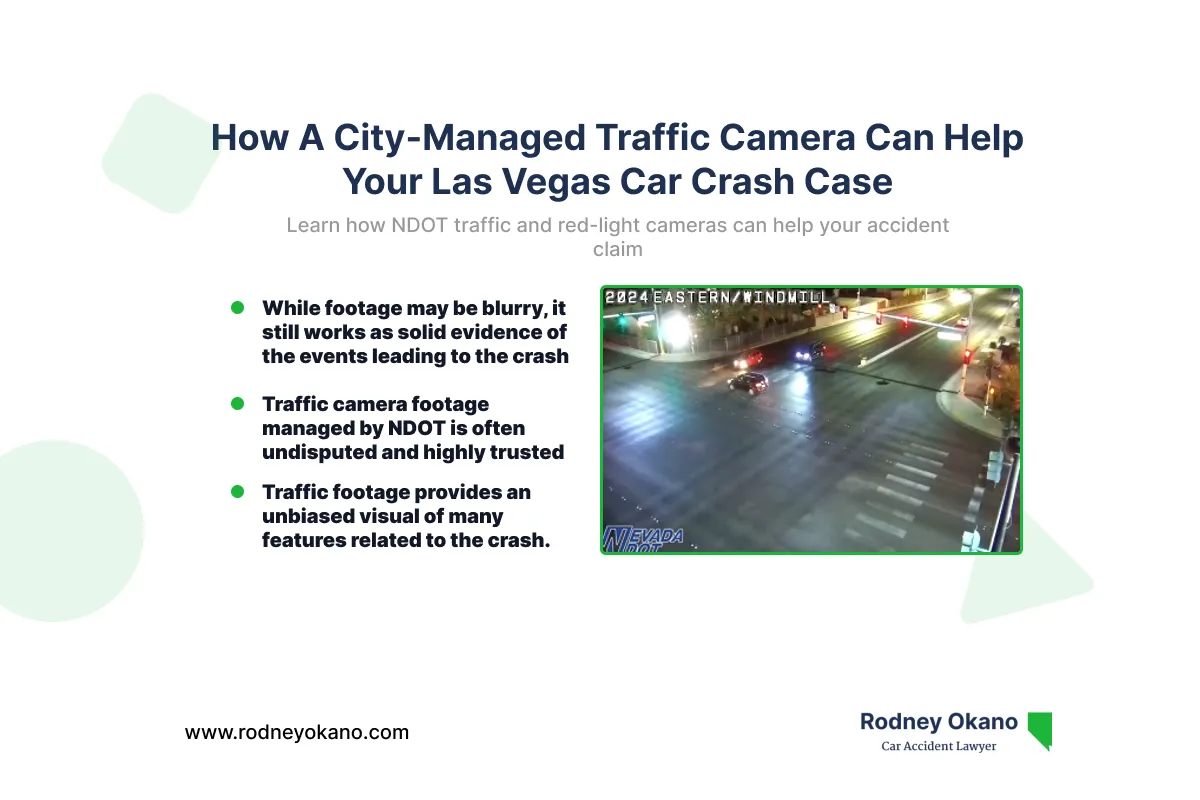
Traffic cameras in Las Vegas are managed by the Regional Transportation Commission of Southern Nevada and NDOT, monitoring over 1,200 intersections across the valley.
These city-owned cameras capture a range of critical details that can directly support your injury claim, including:
- Vehicle positioning before and during impact
- Traffic signal status at the moment of collision
- Approximate vehicle speeds through intersection zones
- Pedestrian and cyclist movement nearby
Unlike surveillance camera footage from private businesses, traffic cameras record with a focus on the road, capturing real-time conditions like weather, visibility, and road congestion. As an experienced attorney in Las Vegas, I've seen this footage reveal details that completely shift liability, particularly when witness statements conflict with physical evidence found at the scene.
How Traffic Cameras Operate in Las Vegas
Traffic cameras in Las Vegas use a closed-circuit television (CCTV) system that streams live footage directly to monitoring centers. Unlike business security cameras, these systems run continuously without interruption, meaning every moment leading up to and following an accident occurs on record.
Accessing this video evidence typically requires purchasing it from a third-party broker, as neither NDOT nor the RTC stores video footage.
What Makes Traffic Camera Footage Useful in Building Your Case
Surveillance footage captured by traffic cameras provides an unbiased, real-time record of exactly how a collision occurred, which carries far more weight than almost any other form of evidence, including witness statements. Unlike personal accounts, video evidence does not contradict itself under cross-examination. Footage can establish:
- Vehicle speed before impact
- Lane positioning and sudden movements
- Signal compliance or violations
- Road and weather conditions at the time
This level of detail gives your case measurable, objective support that opposing counsel cannot easily dispute.
Who Controls Traffic Camera Footage in Las Vegas?
The Regional Transportation Commission of Southern Nevada and the Nevada Department of Transportation both manage and control traffic camera footage across Las Vegas, managing a network that monitors over 1,200 intersections.
To request footage successfully, you generally need to:
- Identify the exact intersection and timestamp
- Specify the incident date and direction of travel
- Utilize a third-party broker, as the RTC or NDOT does not store video footage
- Pay any applicable fees
The process of securing surveillance footage can be difficult after a car accident, which is why it is recommended to let a Las Vegas car accident lawyer do it on your behalf, as once they obtain the footage, they can immediately add to the existing evidence and continue building your claim.
Other City and Municipal Agencies
Beyond the RTC and NDOT, city and municipal agencies, such as the Las Vegas Metropolitan Police Department, also maintain their own surveillance cameras at key locations.
Police departments often capture video footage through body cameras, patrol car dashcams, and fixed security cameras near high-traffic zones.
Submitting a public records request, under NRS Chapter 239, to these agencies can yield valuable video evidence, though each agency enforces its own retention policies, response timelines, and fees.
Can You Obtain Video Footage from Flock Cameras for Your Car Accident
Along with traffic cameras and private surveillance cameras, Flock cameras have become a new footage-capturing tool on our roads. While Flock cameras are controversial, their surveillance camera footage could help in proving fault in your accident case.
While Flock LPR cameras capture still images of vehicles passing, some Flock cameras provide live-video footage, and while this footage is restricted to police and HOAs, your car accident lawyer could be able to request it or file a subpoena as part of the claim or lawsuit.
Like other surveillance camera video, there are deadlines in obtaining it, as Flock automatically deletes most recordings after 30 days, making quick action crucial.
Frequently Asked Questions About Getting Car Accident Footage in Las Vegas
Can I Request Traffic Camera Footage Directly From the City of Las Vegas?
Yes, you can request traffic camera footage from the city through a public records request. However, footage is typically retained for a limited time, often 30 days or less, so acting quickly is critical to preserving this potential evidence for your case.
How Long Do Businesses in Las Vegas Keep Their Security Camera Footage?
Most businesses in Las Vegas retain security camera footage for around 30 to 90 days, though some delete footage much sooner, after around 72 hours.
However, casinos in Nevada must keep surveillance camera recordings for at least 7 days, which will increase to 15 days on April 3, 2027, under Nevada Gaming Control Board regulations.
What Is a Preservation Letter and Do I Need One?
A preservation letter, also known as a litigation hold, is a formal notice demanding that a party retain all relevant evidence related to a potential legal claim. You may need one if you anticipate filing a lawsuit or believe evidence could be destroyed. Sending this letter early helps protect evidence crucial to your case, such as video footage.
Can Dashcam Footage From Another Driver Be Used in My Case?
Yes, dashcam footage from another driver can be used as evidence in your case. This type of third-party footage can be particularly valuable in establishing fault and supporting your claims. However, obtaining this footage requires acting quickly, as many dashcams automatically overwrite recordings after 24 to 72 hours.
Obtain the Compensation You're Entitled To
Contact Us Today
The Rodney Okano Car Accident Lawyer Law Firm is a Las Vegas personal injury law firm that specializes in representing those in car, truck, bus, and motorcycle accidents. Founded in 2001, our law firm has over 20 years of legal experience in Nevada and has remained dedicated to securing the maximum settlement for those injured in motor vehicle accidents. Our firm offers free consultations, which can be set up by calling or sending an email inquiry.