


8 min read time

Table of Contents

Which Assets Are Protected From Creditors in a Nevada Bankruptcy?
Under NRS 21.090, numerous personal assets are protected from being sold during a bankruptcy. These assets include:
- Primary Residence
- Retirement Accounts
- Motor Vehicles
- Tools of the Trade
- Wages and Income Benefits
- Personal Injury Settlements
- Necessary Household Goods and Furniture
To ensure all exemptions are in place and creditors don't liquidate your protected assets, work with a Nevada bankruptcy attorney at Rodney Okano Law Offices who can handle filing and protect your assets. Schedule a free consultation today by calling (702) 566-3600.
Primary Residence
Your primary residence is often one of the most valuable assets you can protect in bankruptcy. Under Nevada's homestead exemption, you can shield up to $605,000 in equity in your primary residence from creditors. This means if your home's market value is less than that amount, or if your home equity (market value - what you owe) is $605,000 or less, you can keep your home without losing it to creditors.
However, if your home's equity exceeds $605,000, you may need to sell the property under Chapter 7 or negotiate a repayment plan with your creditors under Chapter 13.
To maximize protection, it's important to record a homestead declaration with the county recorder before filing bankruptcy. This ensures your home is legally recognized as exempt property.
Retirement Accounts
Nevada protects retirement accounts in bankruptcy. The exemptions cover 401(k)s, IRAs (including Roth), pensions, and profit-sharing plans. You can keep these funds without creditors seizing them.
This applies in both Chapter 7 and Chapter 13 cases.
Motor Vehicles
The Nevada motor vehicle exemption protects up to $15,000 of equity in a motor vehicle. This means that if your car is worth $15,000 or less in equity, it is fully protected from creditors and the bankruptcy trustee.
The motor vehicle exemption is important because it allows you to keep your car, which may be essential for your job or daily life. Without this exemption, creditors could sell your car to pay off your debts.
However, if your equity in the car is more than $15,000, you may need to sell the car to pay off creditors or consider other debt-relief strategies.
Tools of the Trade
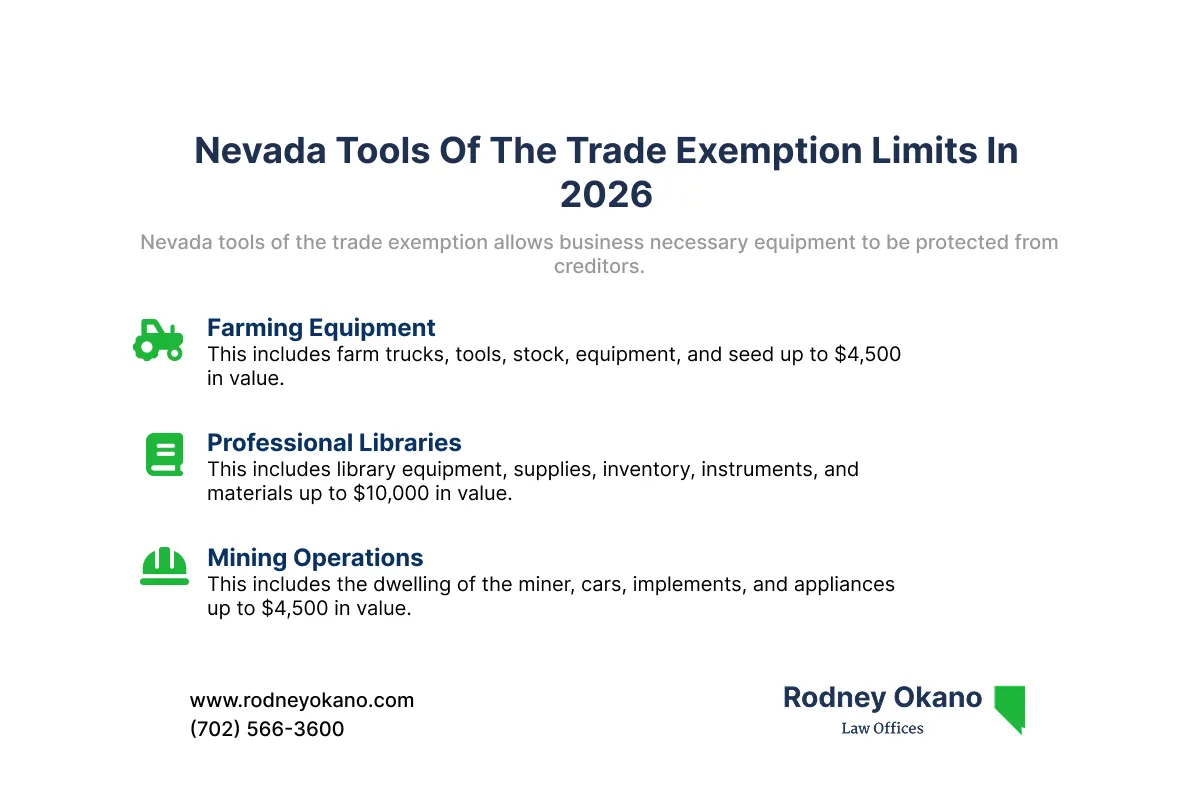
If you use your tools, equipment, or materials to earn your living, you can keep them from being taken by your creditors. Nevada law protects these assets:
Trade Tools | Amount Protected in Dollars |
|---|---|
Farming Equipment, Trucks, and Supplies | $4,500 |
Professional Libraries and Necessary Materials | $10,000 |
Dwelling and Equipment for Mining Operations | $4,500 |
These limits help ensure self-employed individuals and business owners can keep business or trade essential assets. It's especially useful for people who rely on their work as their primary income source.
Wages and Income Benefits
Nevada law also protects a portion of your disposable earnings from garnishment. Disposable earnings means wages after legally required deductions. The protected amount is based on your weekly income and collection rules:
- If your gross weekly wage is $770 or less, you keep 82% of disposable earnings.
- If your gross weekly wage is more than $770, you keep 75% of disposable earnings.
- In all cases, you must keep at least 50 times the federal minimum wage per week under the Fair Labor Standards Act of 1938, if that amount is greater.
The exemptions on disposable income ensure you have enough income to meet basic living expenses while going through bankruptcy.
Personal Injury Settlements
Personal injury settlement funds are protected in Nevada bankruptcy. Nevada law allows you to exempt up to $16,150 of a personal injury settlement in a Nevada bankruptcy case.
This settlement can stem from situations where you got injured due to someone else's negligence, such as car accidents or slips and falls.
Necessary Household Goods and Furniture
Nevada bankruptcy law includes an exemption of $12,000 for essential personal items, including:
- Household furniture and appliances
- Clothing and personal effects
- Medical equipment
- Garden tools and yard equipment
Assets Protected Under the Nevada Bankruptcy Wildcard Exemption
Nevada has a bankruptcy wildcard exemption that allows debtors to exempt up to $10,000 of personal property that wouldn't otherwise be protected under state or federal bankruptcy exemptions. This provision is designed to help individuals protect valuable items, such as collectibles, artwork, second vehicles, or emergency savings, that might otherwise be at risk during bankruptcy proceedings.
The wildcard exemption can be applied to a wide range of personal property items, including:
- Furniture: For debtors who need to retain essential household items.
- Electronics: For individuals looking to keep valuable devices or gadgets.
- Jewelry: For people who want to preserve heirlooms or personal adornments.
- Clothing: For those who need to retain essential or high-value garments.
- Vehicles: For individuals who own multiple cars and wish to keep one.
For married couples filing jointly in Nevada, the wildcard exemption doubles, permitting them to protect up to $20,000 worth of personal property.
How Nevada Bankruptcy Exemptions Work
Nevada has "opted out" of the federal bankruptcy exemptions, meaning residents and non-residents filing for bankruptcy in Nevada must use Nevada's specific exemptions rather than the federal system. This decision was made under Nevada law and allows state bankruptcy law to take precedence over federal bankruptcy law.
These exemptions are designed to protect the essential assets that individuals need to rebuild their lives after filing for bankruptcy.
Federal Exemptions Versus Nevada State Exemptions
Because Nevada has opted out of the federal exemptions, you can't use the federal exemptions, and instead you must use Nevada's exemptions. The federal exemptions are more generous in some categories, so you may think you're missing out. But Nevada offers a high homestead exemption, better wage protection, and a larger wildcard exemption.
Residency Requirements for Claiming Nevada Exemptions
Federal law 11 U.S.C. § 522(b)(3)(A) requires that you have lived in Nevada for at least 730 days (two years) before you can use Nevada exemptions to protect your property. If you haven't lived in Nevada long enough, you'll typically use the exemptions of the state where you lived for most of the 180 days before the two-year period.
How Exemptions Limit What a Trustee Can Liquidate
In a Chapter 7 bankruptcy, a trustee appointed by the bankruptcy court is tasked with liquidating non-exempt assets to repay creditors. However, property that is exempted under Nevada bankruptcy law is shielded from this process and cannot be sold by the trustee.
This means that debtors who have properly claimed exemptions can retain their assets while their non-exempt property is liquidated for creditors.
NRS 21.090 in Defining Exempt Property
NRS 21.090 is the specific Nevada code section that lists and defines the property categories that are exempt from creditors. It includes details about the homestead, motor vehicle, wildcard, and personal property, among other exemptions.
Exempt Assets in Chapter 7 Versus Chapter 13
Chapter 7 and Chapter 13 bankruptcy exemptions work in different ways. In a Chapter 7 case, the bankruptcy trustee can sell non-exempt assets to pay creditors, so the filer keeps only the assets protected by an exemption.
In a Chapter 13 case, the filer can keep all assets, but that comes at a cost. The filer must pay creditors through the repayment plan within a set period of time. A single missed payment could cause the Chapter 13 plan to fail.
Nevada Homestead Exemption Explained
The Nevada homestead exemption protects up to $605,000 of equity in a primary residence from forced sale by general creditors. However, it does not protect against debts secured by a mortgage or deed of trust, payment of taxes, or IRS liens.
Under Nevada law, to qualify for the homestead exemption, the property owner must declare the property as their homestead and record the declaration with the county recorder.
The Nevada homestead exemption is available to all individuals and married couples filing jointly in Nevada bankruptcy proceedings.
Equity Limits for Primary Residences
If your home equity exceeds $605,000, the exemption only protects up to that amount, and the excess is at risk. If your home is worth $900,000 with a $200,000 mortgage, your $700,000 in equity is protected only up to $605,000, leaving $95,000 potentially exposed to creditors.
In bankruptcy, if your equity is over $605,000, your trustee may seek to sell your home and use the proceeds to pay creditors. You can avoid this if you have a plan to repay the excess (for example, in Chapter 13).
Declaration of Homestead Requirements
Nevada law requires you to record a written declaration in the county where the property is located. The declaration must clearly state that you intend to use and claim the property as a homestead. This process protects your home and prevents creditors from selling it to satisfy ordinary debts.
Protection for Mobile Homes and Condominiums
NRS 115.005 defines a "homestead" as property consisting of:
- A quantity of land, together with the dwelling house thereon and its appurtenances;
- A mobile home whether or not the underlying land is owned by the claimant; or
- A condominium unit with its share of the common elements.
This broadens the Nevada homestead exemption beyond traditional homes.
Deep Look into the Nevada Bankruptcy Motor Vehicle Exemption
In Nevada, you can keep one car with up to $15,000 in equity, plus up to $10,000 more under the wildcard exemption, because Nevada lets you stack the wildcard exemption on top of the motor vehicle exemption. So, if your vehicle's equity is $6,000, you're covered, but if it's $30,000, you'll lose $5,000. The trustee will sell the car if the exemption doesn't cover all the equity.
However, it's important to note that you should avoid using the entire wildcard exemption on the car itself.
Special Rules for Vehicles Modified for Disabilities
In Nevada, vehicles that are modified for disabilities are fully exempt from creditors during a bankruptcy. For example, a vehicle installed with a wheelchair ramp that allows a disabled individual to enter is fully exempt. However, the debtor must claim the exemption for the vehicle.
Treatment of Financed and Leased Vehicles
When you file bankruptcy in Nevada, how your vehicle is treated depends on whether it is financed or leased. If you have a loan, you can reaffirm the debt, redeem the vehicle for its market value, or surrender it. If you're behind on payments, the lender can ask the court to lift the automatic stay and repossess the car.
For leased vehicles, the lessor retains ownership, and you may assume the lease, reject it, or negotiate new terms. In either case, bankruptcy law provides options, but the best choice depends on your situation. Speaking with one of our bankruptcy attorneys in Las Vegas can provide clarity on the best choice for your position.
Contact Us Today
The Rodney Okano Law Offices is a Las Vegas Law Firm that specializes in representing those injured in motor vehicle accidents and those looking to become debt-free through Chapter 7 or Chapter 13 bankruptcy. Our firm has been in Nevada for over 20 years and has helped thousands with their car accident claims and bankruptcy filings. We offer a free attorney consultation, which can be set up by calling or sending an email inquiry.