Rodney Okano Car Accident Lawyer
Las Vegas Chapter 7 Bankruptcy Lawyer
20 years of legal experience. 20 years of exceptional results.


Table of Contents
Chapter 7 bankruptcy, commonly referred to as liquidation under Chapter 7 Title 11 of the U.S. Bankruptcy Code, is a legal process designed to help individuals eliminate unsecured debt, including credit card debt, medical bills, and payday loans. Once a petition is filed, the Nevada bankruptcy court issues an automatic stay, which immediately halts creditor actions like wage garnishments and collection calls.
A bankruptcy trustee is then appointed to review your case, examining assets to determine what, if anything, can be liquidated. Qualifying debts that survive this process are typically discharged within 90 to 180 days. The dischargeable debts generally include:
At The Rodney Okano Law Offices, our Las Vegas bankruptcy attorneys specialize in Chapter 7 and can help you obtain a clean slate. Schedule a free consultation to start working with our experienced legal team.
Chapter 13 bankruptcy, by contrast, requires a 3- to 5-year repayment plan for outstanding debts rather than immediate discharge. Chapter 11 is primarily designed for business restructuring, while Chapter 12 applies specifically to family farmers and fishermen.
Chapter 7 stands apart because the bankruptcy discharge typically occurs within 90 to 180 days, making it the fastest path to a fresh start for in-debt individuals.
Eligibility for Chapter 7, however, hinges on passing the means test, which uses disposable income and median income thresholds.
In a liquidation bankruptcy, a bankruptcy trustee identifies and sells non-exempt assets, such as a second home or luxury items, to pay creditors.
If there are still outstanding debts after the sale of non-exempt assets, or if the debtor has no non-exempt assets, the remaining unsecured debts are automatically wiped out through a court order, giving filers a fresh start without the burden of repayment.
However, certain secured debts cannot be cleared through Chapter 7, including:
Those carrying heavy unsecured debts with little to no disposable income or assets tend to gain the most from Chapter 7. Specifically, filers who benefit include:
If you want to determine if Chapter 7 is a best fit for your situation, schedule a free consultation with our Las Vegas bankruptcy lawyers today to find out for free.
To file for Chapter 7 bankruptcy in Las Vegas, you must pass the means test outlined under 11 U.S.C. § 707(b)(2), which compares your income to the Nevada median income.
As of 2026, the Nevada median income for a single-person household sits at approximately $72,222 annually or $6,018 monthly. If your income falls below this threshold, you automatically qualify.
However, if it exceeds the Nevada median income, a more detailed calculation of your monthly disposable income determines eligibility. From my experience handling these bankruptcy cases, filers often overlook that they must also complete a credit counseling course from an approved agency within 180 days before filing, as required under 11 U.S.C. § 109(h)(1).
The means test includes two different calculations:
The median income test takes the average of your gross household income over 6 months before filing, then multiplies it by 12 to determine your annual income. That annual income amount is then compared to the Nevada median income for your household size.
If your annual income is less than the compared-to median income amount, you automatically qualify for a Chapter 7 bankruptcy; however, if your annual income exceeds the median amount, you'll have to proceed with the disposable income test.
The disposable income test determines how much disposable income you have by deducting allowed expenses from your monthly earnings. Common deductions include
If the remaining disposable income falls below a set threshold, you'll be eligible to file for a Chapter 7 bankruptcy; if not, you may have to file a Chapter 13 bankruptcy instead.
Accurate documentation is critical to clearing the means test, particularly when claiming allowed deductions. Records like bank statements, pay stubs, and tax returns help substantiate every expense deduction claimed.
Without proper documentation of your finances, you could risk being disqualified for your Chapter 7 filing in Las Vegas.
Failing the means test doesn't automatically eliminate your bankruptcy options. When income exceeds allowable limits, you may still qualify by:
Chapter 13 requires a structured repayment plan spanning three to five years, making it a strong choice if you have a stable income.
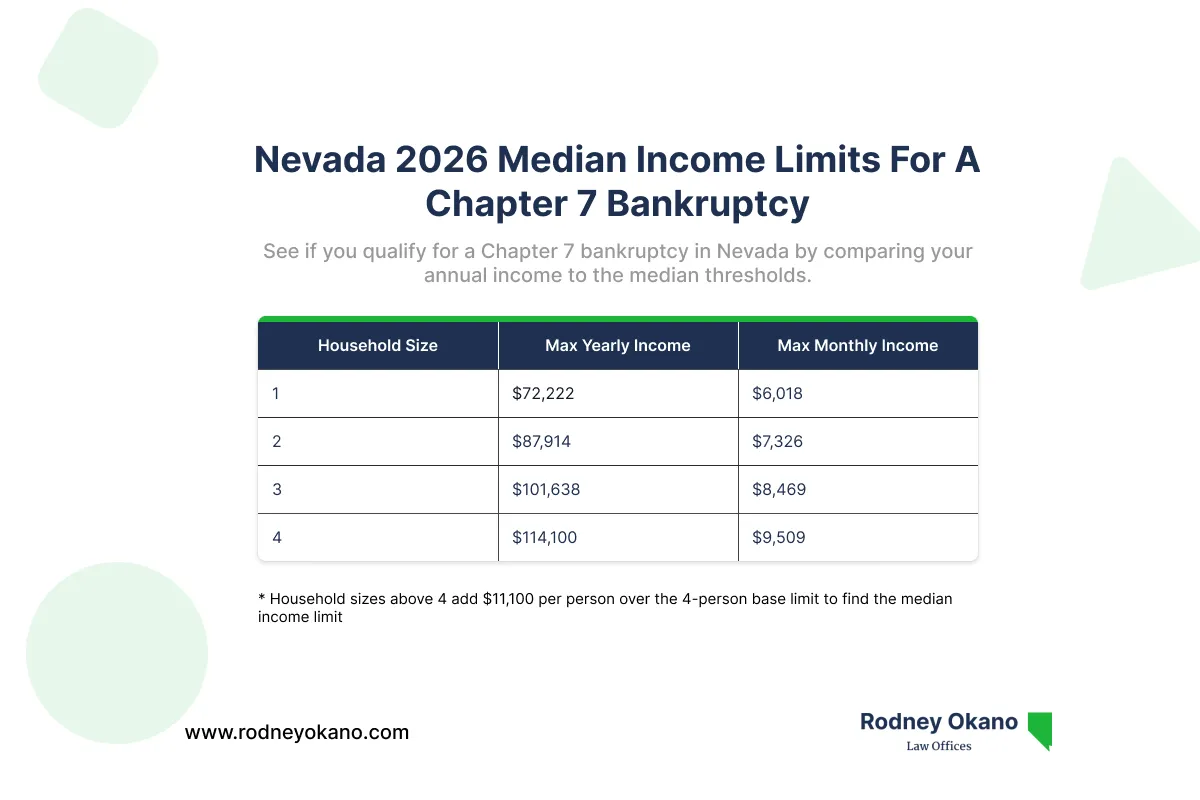
To determine eligibility for a Chapter 7 bankruptcy, you'll have to be making under the Nevada median income limits, which fluctuate every year and adjust based on household size.
In 2026, the Nevada median income limit based on household size is:
To calculate the median income thresholds for households greater than 4, simply add $11,100 per person over the 4-person base limit.
Under 11 U.S.C. § 109(h)(1), a credit counseling course must be completed within 180 days before filing your bankruptcy case through an agency approved by the U.S. Trustee Program. The bankruptcy filing process requires a certificate of completion as proof, which must be submitted alongside your petition. Approved courses typically cover:
The course itself usually takes 60 to 90 minutes and costs between $15 and $50; however, the cost of the course can be waived if you qualify for a fee waiver.
The U.S. Trustee Program maintains a list of approved credit counseling agencies that provide counseling in Nevada. Some of the Nevada-approved credit counseling agencies listed are:
It's important to understand that even though some of the agencies are located in different states, they are still approved to provide credit counseling in Nevada.
Upon completing the course, you receive a certificate valid for 180 days, which must accompany your bankruptcy petition. To stay within that window, time your enrollment carefully:
Working with the Las Vegas bankruptcy lawyers at The Rodney Okano Law Offices can help ensure that your certificate remains valid and other documents are properly filed during your bankruptcy proceeding.
Many people believe that filing for Chapter 7 bankruptcy means losing everything they own, but that misconception often prevents them from pursuing legitimate debt relief.
In reality, Chapter 7 primarily targets non-necessary assets while clearing unsecured debts like credit card balances and medical bills, and protecting significant assets through many exceptions.
Another widespread myth is that the bankruptcy process permanently destroys your credit, when in fact, the discharge typically appears on your credit report for 10 years but allows rebuilding to begin almost immediately after. People also incorrectly assume that all debts are wiped clean, overlooking that student loans, child support, and certain tax obligations survive discharge.
Nevada's bankruptcy exemptions specifically shield essential property like your home equity up to $605,000 under NRS Chapter 115, retirement accounts, and a vehicle up to $15,000.
The trustee only liquidates non-exempt assets that are not protected by exemptions, which many filers don't even have, making most Chapter 7 cases in Nevada "no-asset" cases.
A Chapter 7 filing stays on your credit report for 10 years under the Fair Credit Reporting Act, yet rebuilding your credit score often begins sooner than most expect. Many filers see score improvements within 12 to 24 months through:
The American Bankruptcy Institute refers to Chapter 7 as the single most effective way to eliminate debt, with a 2014 study of 172 cases seeing all successful discharges but in 3 cases.
The immediate debt relief provided by Chapter 7 doesn't mean financial failure but instead a financial reset, allowing filers to start new with their financial situation.
Under 11 U.S.C. § 727, the Chapter 7 bankruptcy process can wipe out a range of unsecured debts, giving filers in Las Vegas a genuine path toward financial freedom.
Dischargeable debts commonly include:
What makes Chapter 7 particularly powerful is its reach beyond simple credit card debt. For instance, certain older tax debts may qualify for discharge if they meet specific IRS timing rules, such as being at least three years old and assessed at least 240 days before filing.
Lease obligations and deficiency balances from repossessed vehicles can also be eliminated, cutting ties to debts that would otherwise follow a filer for years.
Medical bills are among the most commonly discharged unsecured debts in Chapter 7 cases, covering a wide range of healthcare-related obligations:
Roughly 66.5% of all U.S. bankruptcies are tied to medical expenses, making it one of the most common reasons for bankruptcy.
Credit card balances and personal loans are classified as unsecured debts, making them fully dischargeable. Unlike secured debts tied to collateral, these obligations carry no asset backing, so creditors have limited recourse once a Nevada court grants the discharge.
The average American household carries roughly $10,479 to $11,153 in credit card debt, and Chapter 7 can eliminate that entire balance, along with accumulated interest and penalty fees.
Under a lease agreement, Chapter 7 bankruptcy can discharge unpaid rent obligations and related repossession claims as unsecured debts, particularly when a tenant has already vacated the property. The automatic stay under 11 U.S.C. § 362 temporarily halts repossession actions the moment a case is filed, giving debtors immediate relief.
However, landlords can petition the court to lift the stay, and future lease obligations remain non-dischargeable, meaning only pre-petition arrears qualify for elimination.
Civil judgments from auto accidents fall into a gray area under Chapter 7. If the accident involved negligence, the resulting civil judgment is typically dischargeable as an unsecured debt. However, judgments stemming from:
...are non-dischargeable under 11 U.S.C. § 523(a)(9), leaving those debts intact after bankruptcy proceedings conclude.
Under 11 U.S.C. § 523(a), certain debts survive Chapter 7 discharge entirely. These non-dischargeable debts include:
The bankruptcy process does not touch these obligations, regardless of how large they grow. For example, federal student loan balances averaging $40,467 remain fully collectible after discharge, leaving many Las Vegas filers still managing significant financial burdens post-bankruptcy.
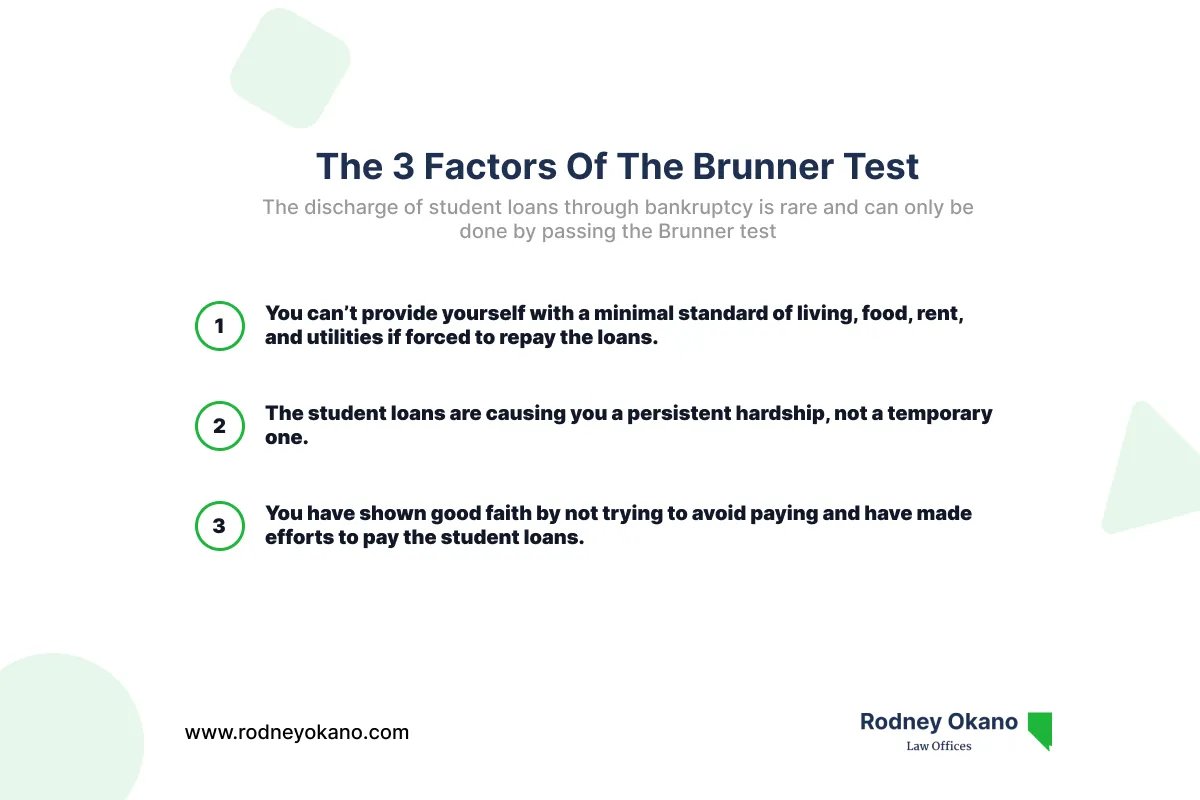
Under 11 U.S.C. § 523(a)(8), student loans are non-dischargeable unless you prove "undue hardship" through the Brunner test, which analyzes:
The Brunner test is notably strict about its factors, and most students in debt will not pass it.
Under 11 U.S.C. § 523(a)(5), child support and alimony are explicitly non-dischargeable in Chapter 7 bankruptcy. These obligations, classified as "domestic support obligations," survive the bankruptcy process entirely intact. Whether arrears have accumulated over months or years, the full balance remains legally enforceable.
Secured debts attach directly to collateral, meaning a mortgage lender retains the right to foreclose even after a Chapter 7 discharge. The discharge eliminates your personal liability for the debt, but the lien survives under 11 U.S.C. § 506. Practically, this means:
Secured debts and mortgage obligations can be complex topics, so it's best to speak with our Las Vegas bankruptcy attorneys to ensure you are on the right path.

Nevada has many bankruptcy exemptions, which are important to understand, and the limits on those exemptions:
A Las Vegas bankruptcy attorney from The Rodney Okano Law Offices can help you determine which assets of yours fall under exemptions.
Schedule a
Free Consultation
Our Practice Areas
Areas We Serve

Attorney Rodney Okano is a skilled Las Vegas attorney who has over 20 years of legal experience in the state of Nevada. Through his extensive legal career, he has helped thousands of clients in their personal injury and bankruptcy matters.
Contact Attorney Rodney OkanoSee why our clients trust us with their legal matters.

Rodney Okano is terrific. We weren't even clients and he researched our legal issues, gave us personalized legal advice in a free consultation, and basically solved our legal problem without even a retainer! And based on his conclusions, he
I can honestly say, Mr Okano and His staff took care of all my needs.....I will forever use them!
He is the Best!!!Answered all our questions and very well knowledgeable. Very reasonable!!!I would highly recommend for anyone to come and talk with him. Also has the best