Rodney Okano Car Accident Lawyer
Las Vegas Head-On Collision Lawyer
20 years of legal experience. 20 years of exceptional results.

Call a Lawyer Now - It's Free

$41,500.00
Car Accident w. Minor Property Damage
$119,500.00
Neck & Arm Car Accident Injury
$25,000.00
Back Pain from Car Accident
$165,000.00
Concussion from Car Accident
$25,000.00
Whiplash Injury from Car Accident
$150,000.00
RTC Bus Accident

Table of Contents
One of the most dangerous crash types requires one of the strongest legal approaches, which is exactly what you'll find at The Rodney Okano Car Accident Lawyer Law Firm.
With over 20 years of legal experience, our Las Vegas personal injury attorneys understand the complications a head-on crash can bring and understand how to counter them and maximize your financial settlement.
Schedule a free consultation with a head-on collision lawyer from our law firm to begin working on your personal injury claim.
Head-on car accidents are among the most fatal crash types because of the forces involved when two vehicles strike each other from opposite directions. When head-on collisions happen at speeds near 70 mph, severe disability or death becomes nearly guaranteed, and survival rates at 50 mph drop to roughly 31%.
The combined high speeds of both vehicles significantly amplify the impact, which is why serious injuries such as spinal cord injuries, traumatic brain injuries, and internal organ damage are so prevalent in these crashes.
Sudden deceleration forces both vehicles to absorb their combined momentum simultaneously, concentrating energy at the point of impact. This causes:
Head-on collisions account for roughly 14% of all fatal motor vehicle accidents, killing approximately 15,744 people between 2016 and 2018 per the Federal Highway Administration. Unlike rear-end crashes, these collisions force both vehicles to absorb combined momentum simultaneously, leaving collision victims with a wide range of severe injuries including:
Las Vegas's mix of high-speed highways, dense urban roads, and consistent nightlife creates conditions where head-on collisions turn fatal fast. On major roads such as Flamingo Road or Fort Apache Road, the risk of an impaired driver driving into an oncoming lane due to Las Vegas's nightlife is real.
Whereas on a major highway such as the I-15, a wrong-way driver has a chance to collide head-on with another driver at speeds of 65 mph or higher.
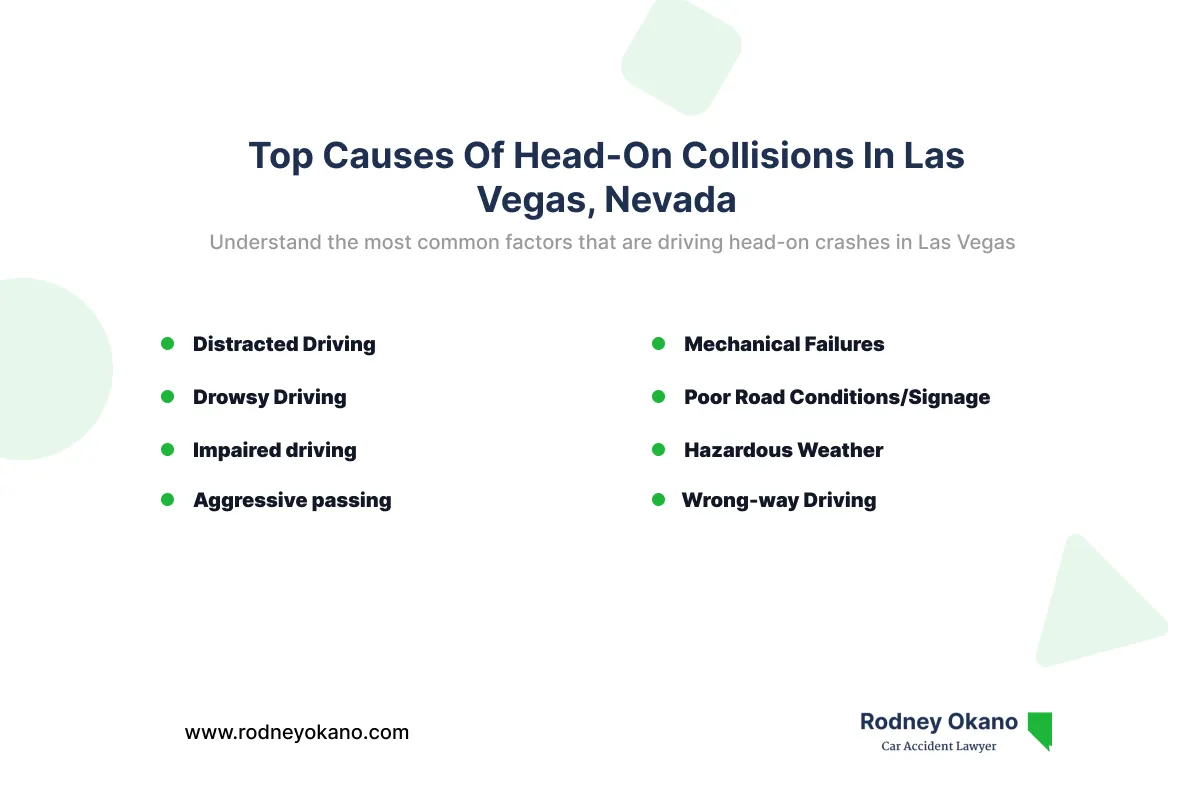
Several factors consistently push drivers into this dangerous car accident type across Las Vegas roads. Based on patterns seen in personal injury cases, these causes appear most frequently:
Passing attempts on two-lane roads are particularly dangerous because drivers routinely misjudge the distance needed to complete the maneuver safely, sending them directly into oncoming traffic at high closing speeds, with medical help often being miles away.
Wrong-way drivers enter freeway on-ramps and interchange ramps traveling against traffic, often due to impairment or ignored traffic signs. These entries force head-on collisions at combined speeds exceeding 120 mph, resulting in:
Driving under the influence of alcohol or controlled substances is a leading cause, as impaired drivers experience:
Those convicted of DUI in a head-on car accident face punitive damages alongside victim reimbursement obligations.
Drowsy driving on desert highways like U.S. Route 95 frequently causes drivers to drift into the opposite lane. Fatigued drivers experience:
Attempting to pass in a no-passing zone or passing without correct judgment is extremely dangerous, yet drivers routinely misjudge available sight distance on two-lane roads or pass on a solid line, pulling into oncoming lanes and leaving no room for evasive action when a vehicle appears ahead.
Distracted driving can cause drivers to veer into oncoming lanes, with phone use, navigation checks, and in-vehicle controls being common triggers. This behavior is especially dangerous on roads with:
Specific highways and roads in Las Vegas see disproportionately high rates of head-on crashes due to their road design and traffic patterns. The most notable include:
Roads lacking proper medians or clear lane markings leave little physical separation between opposing traffic, allowing for head-on collisions, making road maintenance a critical factor in preventing serious injuries or wrongful death.
U.S. Route 95 and I-15 interchange ramps are among the most dangerous freeway segments, where speeds are high, and drivers often face highway hypnosis or are impaired.
Routes like U.S. Route 93 near Boulder City and State Route 160 toward Pahrump are notorious two-lane corridors where:
Missing signage, faded lane markings, and poorly designed intersections create conditions where frontal collisions become nearly inevitable. Government agencies can be held liable for these failures and face negligence claims if the road design directly contributes to lane departure crashes.
Head-on collisions leave victims with severe injuries ranging from traumatic brain injuries to full spinal paralysis. At 70 mph, severe disability or death is nearly guaranteed. Specific injuries include:
Getting compensated for these injuries can be a complicated legal process, so it's crucial to work with an experienced Las Vegas head-on collision lawyer from The Rodney Okano Car Accident Lawyer Law Firm who can focus on your claim while you focus on recovery.
TBIs rank among the most catastrophic outcomes, often resulting in permanent cognitive deficits. Common skull fracture types include:
The impact from head-on collisions frequently causes contrecoup injuries, where brain tissue rebounds against the opposite skull wall.
The force of a head-on crash frequently compresses or severs the spinal cord, leading to outcomes that include:
These injuries require detailed medical documentation to support claims for lifetime care costs.
Rib fractures and sternal breaks commonly occur in serious car accidents and often result from seatbelt compression or impact with a hard object. Crush injuries to the chest can lacerate the aorta, an injury linked to fatalities.
Seatbelt compression and steering column intrusion can rupture the following organs during head-on crashes:
The impact often leads to collapsed lungs and internal bleeding, both requiring immediate surgical intervention and extended medical care.
Crushing forces in head-on collisions can necessitate limb amputation, while fuel ignition leads to burns causing permanent scarring. These injuries carry:
Compensation for these injuries extends past financial needs to the real daily pain a victim suffers, both physically and mentally.
Psychological trauma from head-on collisions often develops into PTSD, affecting a victim's ability to work and function daily. Common psychological effects include:
Nevada law recognizes these as compensable personal injury damages under non-economic losses.
Multiple parties can be held liable in a Las Vegas head-on collision case, depending on the specific circumstances of the crash. Liability commonly falls on:
The Nevada fault-based insurance system requires proving that the at-fault party breached a duty of care, which led to your injuries. A personal injury attorney from our law firm can work with accident reconstruction specialists to build a strong liability case against the responsible party.
Under the Nevada fault-based system, the at-fault driver is legally required to compensate injured parties for:
This obligation is triggered once a duty of care breach is proven and a settlement is reached.
When a commercial truck, delivery vehicle, or rideshare car is involved, employer liability depends on:
Pursuing claims against these companies requires thoroughly investigating those relationships to seek compensation effectively, making it crucial to have a car accident attorney.
Rideshare company liability hinges on key factors, including:
When a rideshare driver crosses into oncoming traffic, the company's negligence in vetting that driver becomes central to seeking compensation in a personal injury case.
Missing signage, faded lane markings, and poorly designed intersections can contribute to head-on collisions. Government agencies responsible for road maintenance may be held liable when negligent road care played a role, including:
Defects like stuck accelerators, faulty brakes, or tire blowouts can force vehicles involved into oncoming traffic. Liable parties may include:
Engineering experts are often needed to help establish these automotive safety failures.
Nevada follows a modified comparative negligence rule under NRS 41.141, which makes your compensation reducible by your percentage of fault in the collision. Additionally, if you are 51% or more at-fault, you are barred from recovering any compensation.
Key fault factors evaluated when determining fault in head-on collision cases include:
Insurance companies actively use this law to minimize your personal injury case value and get you into accepting a quick settlement, so it's crucial to have an attorney handle communications with insurers for you.
Under NRS 41.141, compensation is reduced by your percentage of fault, and reaching the 51% fault threshold bars recovery entirely. For example, if found 30% at fault on a $100,000 personal injury case, your settlement reduces to $70,000, directly cutting financial support for medical care and lost wages.
A police report, medical records, video footage, and witness statements form the core evidence needed to establish fault. This evidence is crucial but can be hard to gather and use to build a case, so working with a Nevada attorney is highly recommended.
Traffic citations issued at the crash scene serve as direct evidence of fault. Law enforcement reports citing violations like illegal passing or DUI can:

After a head-on collision in Las Vegas, move to safety and call 911 immediately. Seek medical attention even without visible symptoms, as injuries like whiplash or internal bleeding may not appear right away. Document the scene by photographing vehicle damage and collecting witness information. Avoid posting about the accident on social media, as insurance companies may use your posts against your claim. Contact a head-on collision lawyer to start your claim.
Under the Nevada statute of limitations, you have two years from the date of your accident to file a personal injury or wrongful death claim, per NRS 11.190(4)(e). Property damage claims have a three-year deadline. Missing these deadlines can permanently bar your right to compensation.
In a Las Vegas head-on collision case, you may recover economic damages like medical expenses, lost income, property damage, and rehabilitation costs. You can also recover non-economic damages such as pain and suffering, loss of enjoyment of life, and permanent disability.
Las Vegas lawyers determine liability by investigating evidence like police reports, surveillance footage, and accident reconstruction analysis. They examine factors such as distracted driving, impaired driving, and road design.
Most Las Vegas head-on collision lawyers work on a contingency fee basis, meaning you pay nothing unless they win your case. This arrangement eliminates upfront costs, making legal representation accessible regardless of your financial situation. Initial consultations are typically free, allowing you to explore your options without any financial commitment before deciding how to proceed with your claim.
 |
00:58
|
00:58
See how Attorney Rodney Okano helps clients get the compensation they're entitled to regardless of the odds.
Schedule a
Free Consultation
Our Practice Areas
Areas We Serve

Attorney Rodney Okano is a skilled Las Vegas attorney who has over 20 years of legal experience in the state of Nevada. Through his extensive legal career, he has helped thousands of clients in their personal injury and bankruptcy matters.
Contact Attorney Rodney OkanoSee why our clients trust us with their legal matters.

I highly recommend Rodney Okano & his team. I would give them 10 stars if it was allowed. They were professional, & very helpful. Great communication. His legal assistant Jacqueline was truly awesome & kept me updated every step of the way through text, phone call & email.
Good people ,excellent service ,really on point and guide you from A -Z, im really happy with them ,highly recommend to families and friend and thank you so so much to helping us
Though the process was lengthy i feel Mr. Okano was the right person to handle my case. Very professional and i feel he did everything to get what I deserved if i ever am in need of an attorney he would most definitely be the first person i would contact a pleasure to work with!