Rodney Okano Car Accident Lawyer
Las Vegas Rear-End Collision Lawyer
20 years of legal experience. 20 years of exceptional results.

Call a Lawyer Now - It's Free

$41,500.00
Car Accident w. Minor Property Damage
$119,500.00
Neck & Arm Car Accident Injury
$25,000.00
Back Pain from Car Accident
$165,000.00
Concussion from Car Accident
$25,000.00
Whiplash Injury from Car Accident
$150,000.00
RTC Bus Accident

Table of Contents
Rear-end collision cases are among the most common types of auto accident claims seen by insurers and attorneys, yet many insurers are still bold enough to argue settlement values, and most attorneys lack the legal expertise needed to prevent their clients from suffering reduced compensation.
However, at The Rodney Okano Car Accident Lawyer Law Firm, we reversed that by using our over 20 years of legal experience to secure maximum compensation for our clients through aggressive fighting techniques and strong case building.
Work with a dedicated personal injury lawyer who understands the legal process in a rear-end collision and won't stop till you are compensated by contacting our law firm today for a free consultation.
A rear-end collision occurs when one vehicle strikes the car ahead of it from behind, and in Las Vegas, these crashes are among the most frequently reported auto accidents.
Distracted driving accidents account for a significant percentage of rear-end collisions, as drivers who are texting, adjusting navigation, or simply not paying attention often fail to brake in time. Speed, sudden stops by the lead vehicle, and poor road conditions also contribute to rear-end accidents.
Under Nevada law, the trailing driver is generally presumed liable, since they are responsible for maintaining a safe following distance.
Tailgating is one of the most overlooked yet dangerous behaviors on Las Vegas roads, directly violating NRS 484B.127, which requires drivers to maintain a "reasonable and prudent" following distance. When a fault driver closes that gap at highway speeds, even a brief moment of inattention leaves zero room to brake.
Event data recorder (EDR) downloads frequently confirm that the trailing vehicle never decelerated before impact. Beyond tailgating, heavy Strip traffic creates sudden speed differentials where leading vehicles brake sharply while following drivers, often distracted, fail to react. Skid marks at the accident scene, combined with surveillance footage, can reveal exactly how little stopping distance existed before the collision.
Texting while driving makes a driver 23 times more likely to crash. Smartphone use while driving causes:
These factors delay braking response, directly causing Las Vegas rear-end car accidents.
Nevada Revised Statute 484B.127 sets the legal standard for following distances, and violations directly cause rear-end crashes. Tailgating eliminates critical reaction time, resulting in:
Speeding amplifies stopping distances significantly, and at 65 mph, a vehicle needs roughly 316 feet to stop safely. Reckless behaviors that worsen this risk include:
These actions directly increase the likelihood of serious injuries sustained in rear-end crashes.
Impaired drivers have significantly slower reaction times, making rear-end collisions far more likely. In Las Vegas, where nightlife runs 24/7, drunk driving remains a persistent danger. Blood alcohol concentrations as low as 0.08% under Nevada law legally impair judgment, yet even lower levels measurably reduce braking response, leaving trailing drivers unable to avoid auto accidents.
Sudden speed differentials in Las Vegas Strip traffic create dangerous braking scenarios where leading vehicles stop suddenly near intersections. Insurance companies frequently dispute these claims by arguing the accident occurred due to road conditions rather than negligence.
Witness statements and police reports directly counter those arguments, establishing a clear record of how the collision unfolded and supporting a car accident claim effectively.
Certain stretches of Las Vegas roads see rear-end collisions far more frequently than others. The Las Vegas Strip, particularly between Tropicana Avenue and Spring Mountain Road, sees constant stop-and-go traffic that creates dangerous speed differentials. Beyond the Strip, other high-risk locations include:
These roads and highways consistently appear in Las Vegas Metropolitan Police Department crash reports as collision-dense zones. Rear-end auto accident rates are particularly high in these areas during peak commute hours between 7-9 AM and 4-7 PM.
Rear-end collisions are often not seen as severe accidents among other types but frequently involve traumatic brain injury, spinal damage, and shoulder injuries that may not surface for days after impact.
Insurance companies commonly exploit this delayed onset to minimize settlements. Nevada's two-year filing window, while seemingly generous, shrinks quickly as critical evidence like EDR data and traffic camera footage gets overwritten or destroyed, making it crucial to identify these injuries and work with a Las Vegas personal injury attorney as soon as possible.
Rear-end collisions in Las Vegas frequently produce injuries that extend well beyond visible bruising or immediate pain. Whiplash, for instance, occurs when the neck snaps violently forward and backward, straining ligaments and cervical discs in ways that worsen over days. Brain injuries from rear impacts are particularly deceptive, as concussive symptoms like cognitive fog and chronic headaches may surface long after the crash.
Spinal disc herniation is another common result, sometimes requiring surgical intervention that drives treatment costs well beyond initial estimates. Pursuing compensation for these injuries means documenting every symptom carefully, since Nevada's at-fault system places full financial liability on the driver who caused the collision, but requires strong proof of injury.
Soft tissue injuries from rear-end collisions involve microscopic tears in muscles, tendons, and ligaments that standard X-rays frequently miss. Physical therapy becomes essential for recovery, yet insurers often dispute these injuries due to their invisible nature. Documented evidence of whiplash should include:
Rear-end impacts compress spinal discs with extreme force, causing herniation or bulging that presses against nearby nerves. This pressure produces:
Surgical intervention is frequently required for severe cases.
Rear impacts generate enough force to cause the brain to slam against the skull's interior, resulting in contusions or diffuse axonal injury. Symptoms like cognitive fog, memory loss, and chronic headaches often surface days later, complicating personal injury claims. Common delayed TBI indicators include:
Chronic back and neck injuries from rear-end collisions often demand years of medical treatment, generating substantial medical bills. Injuries requiring long-term care typically include:
Seeking compensation for these ongoing costs under Nevada law requires detailed medical records linking each diagnosis to the collision, which an experienced lawyer from The Rodney Okano Car Accident Lawyer Law Firm can help do.
Fractured ribs, broken wrists, and internal organ damage are among the most physically devastating results of rear-end crashes. The sudden force can rupture the spleen or cause internal bleeding, which may not surface immediately.
Rear-end collisions force the lumbar and cervical vertebrae to absorb sudden, violent compression, driving the disc's soft nucleus pulposus through its outer fibrous ring. This rupture specifically targets:
Resulting nerve compression produces radiating pain, numbness, and measurable loss of motor function.
Nevada operates as an "at-fault" state, meaning the driver who caused the rear-end collision bears direct financial responsibility for resulting damages. Fault in these car accident cases typically traces back to specific behaviors, including:
Under Nevada law, proving which party caused the crash is central to recovering medical expenses, lost wages, and property damage. Objective evidence, rather than competing driver statements, determines liability. Las Vegas Metropolitan Police Department crash reports, event data recorder downloads, and traffic camera footage are among the strongest tools used to establish fault and hold the responsible party accountable.
Under Nevada's modified comparative negligence rule, NRS 41.141, your recovery is reduced by your assigned fault percentage, but barred entirely if you're found 51% or more responsible, directly impacting your final compensation for non-economic and economic damage.
A sudden brake check or illegal lane change by the front driver can shift partial fault under NRS 41.141, directly reducing your compensation by the assigned fault percentage, if you happen to be the front driver.
Defective vehicle parts, poorly maintained roadways, or negligent cargo loading by a trucking company can all shift liability beyond the trailing or front driver. Under Nevada law, multiple parties can share fault, meaning a vehicle manufacturer or municipality could face accountability for contributing to a rear-end auto accident.
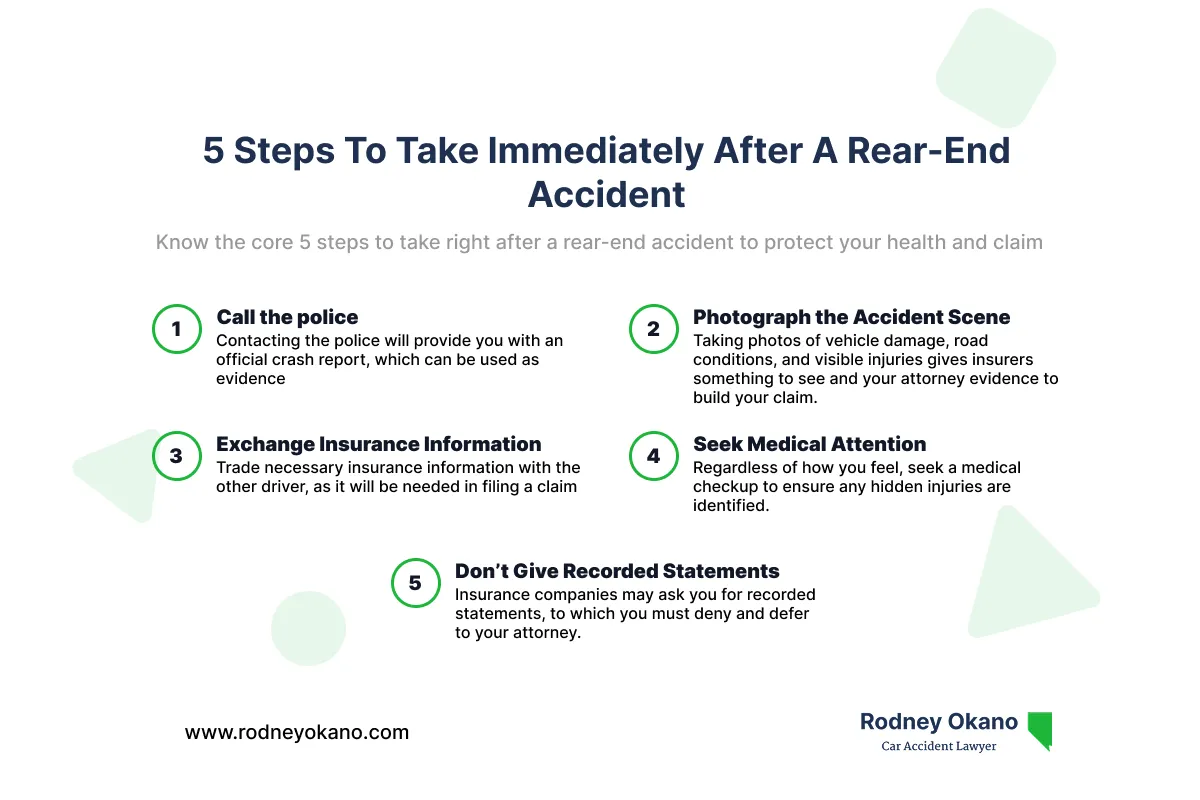
After a Las Vegas rear-end collision, acting quickly protects both your health and your personal injury claim. Evidence like dashcam footage, traffic camera recordings, and event data recorder (EDR) downloads can disappear fast, so acting fast is crucial. Taking these steps immediately strengthens your position:
Under Nevada law, you have two years from the accident date to seek compensation, making prompt action critical to recovering medical expenses and lost wages.
Nevada law requires drivers involved in a rear-end collision to report the crash to law enforcement immediately. Contacting the Las Vegas Metropolitan Police Department ensures an official report is filed, which becomes critical evidence when the claims process begins. This report typically documents:
Capture photos of vehicle damage, road conditions, skid marks, and traffic signals from multiple angles. Written notes on weather, time of day, and driver behavior at impact are equally critical, as insurers often dispute causation.
Gathering witness phone numbers and names on the spot strengthens your rear-end collision case significantly. Bystanders who saw the crash can confirm fault, support police reports, and counter insurer disputes. Prioritize collecting:
Delays in treatment can directly undermine your claim, as insurers use gaps in care to dispute injury severity. Seek evaluation immediately, even if you feel fine, because symptoms like whiplash often surface 24-72 hours later. Prioritize:
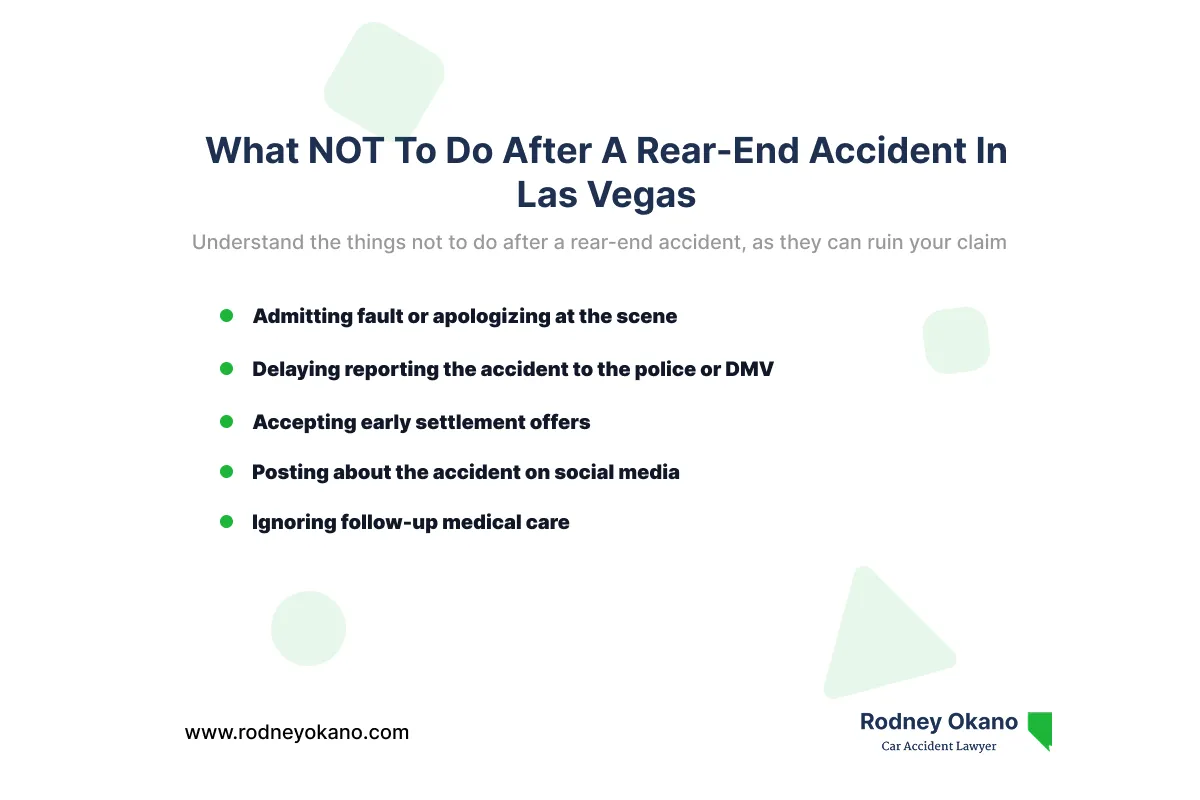
After a Las Vegas rear-end accident, certain mistakes can quietly destroy your claim before it even begins. Avoiding these critical errors protects your right to recover compensation:
Committing just one of the mentioned errors can significantly devalue your case.
Insurance companies routinely challenge rear-end collision claims by targeting Nevada's modified comparative negligence rule. Adjusters often argue the front driver contributed to the crash through sudden, unjustified braking or inoperable brake lights, intentionally inflating your fault percentage to reduce or eliminate your payout.
They also frequently dispute medical expenses tied to delayed-onset injuries, like whiplash, by arguing those injuries existed before the collision. Without strong physical evidence and the power of an attorney, insurers can successfully shift fault onto you.

After a rear-end collision in Las Vegas, call 911 immediately, exchange insurance information, and photograph the scene and vehicle damage. Seek medical attention even if symptoms seem mild, as injuries like soft-tissue damage can appear delayed. Contact an attorney to explore your potential legal options.
Nevada's statute of limitations gives injured parties two years from the date of a rear-end crash to file a personal injury lawsuit. Missing this deadline typically eliminates your right to compensation entirely.
In a Las Vegas rear-end collision case, you may recover medical expenses, lost wages, and pain and suffering damages. Some cases have resulted in significant recoveries, such as a $4.8 million settlement, though outcomes depend on the specific facts of each case.
Fault in a Las Vegas rear-end collision is typically proven through evidence like crash reports, vehicle damage photos, witness statements, dashcam footage, and event data recorder downloads.
Most rear-end collision lawyers in Las Vegas work on a contingency fee basis, meaning you pay nothing upfront and only owe legal fees if you win. This "no win, no fee" arrangement typically ranges from 33% to 40% of the settlement. Many firms also offer free consultations, making it financially accessible to pursue compensation.
 |
00:58
|
00:58
See how Attorney Rodney Okano helps clients get the compensation they're entitled to regardless of the odds.
Schedule a
Free Consultation
Our Practice Areas
Areas We Serve

Attorney Rodney Okano is a skilled Las Vegas attorney who has over 20 years of legal experience in the state of Nevada. Through his extensive legal career, he has helped thousands of clients in their personal injury and bankruptcy matters.
Contact Attorney Rodney OkanoSee why our clients trust us with their legal matters.

Very communitcative ms.jackie I love her service
If you have no choice but to file bankruptcy this is the firm to use. Rodney was so compassionate and understanding, Jackie was unbelievable, always available for us and returned every call very promptly.
Rodney Okana and his right hand Jackie, were absolutely amazing. They handled my case in the best timely manner. I felt confident the whole process through. They made me felt taken care of and walked me through the whole process. I