


9 min read time

Table of Contents

Nevada Traffic Laws and Cyclist Protections
Under Nevada Revised Statutes (NRS) 484B.270, drivers must maintain a safe distance of at least 3 feet when passing cyclists on any road. Beyond that, NRS 484B.763 grants cyclists the same legal rights and responsibilities as vehicle operators, meaning violated traffic laws apply equally to both parties when determining liability.
Nevada also enforces a strict liability standard in bike lanes, where drivers who encroach onto a bike lane can face immediate traffic citations and liability. Distracted driving violations under NRS 484B.165 further expose drivers to serious legal consequences in any accident.
The Legal Rights Cyclists Have on Nevada Roads
Under NRS 484B.763, cyclists have the legal right to use public roads just as motor vehicle drivers do. Riders must follow the same traffic signals and speed limit rules that apply to all road users. In urban areas, cyclists may use full lanes when bike lanes are unavailable or unsafe.
Nevada law also requires drivers to maintain at least 3 feet of clearance when approaching cyclists, providing riders with enforceable protections against negligent vehicle operators.
How Nevada's Share-the-Road Laws Apply to Drivers
According to NRS 484B.270, drivers must pass cyclists with at least 3 feet of clearance. Failing this standard can trigger serious legal consequences, including traffic citations and civil liability. When a vehicle collides with a bicycle due to insufficient space, the driver may be liable for the injured cyclist's damages and injuries.
Nevada's share-the-road requirements place the burden of safe passing directly on drivers operating near bike lanes.
Designated Bike Lanes and Driver Responsibilities in Nevada
Under Nevada Revised Statute 484B.270, drivers must yield to cyclists traveling within designated bike lanes and are prohibited from blocking or driving in those lanes except when making a turn or entering a driveway. When a driver crosses into a bike lane without checking for cyclists, the resulting traffic violations can directly establish civil liability in a bicycle accident.
Nevada law treats bike lanes as protected spaces, meaning any encroachment that causes injuries almost always results in 100% liabilty for the encroaching driver.
Immediate Steps to Take After Hitting a Cyclist in Nevada
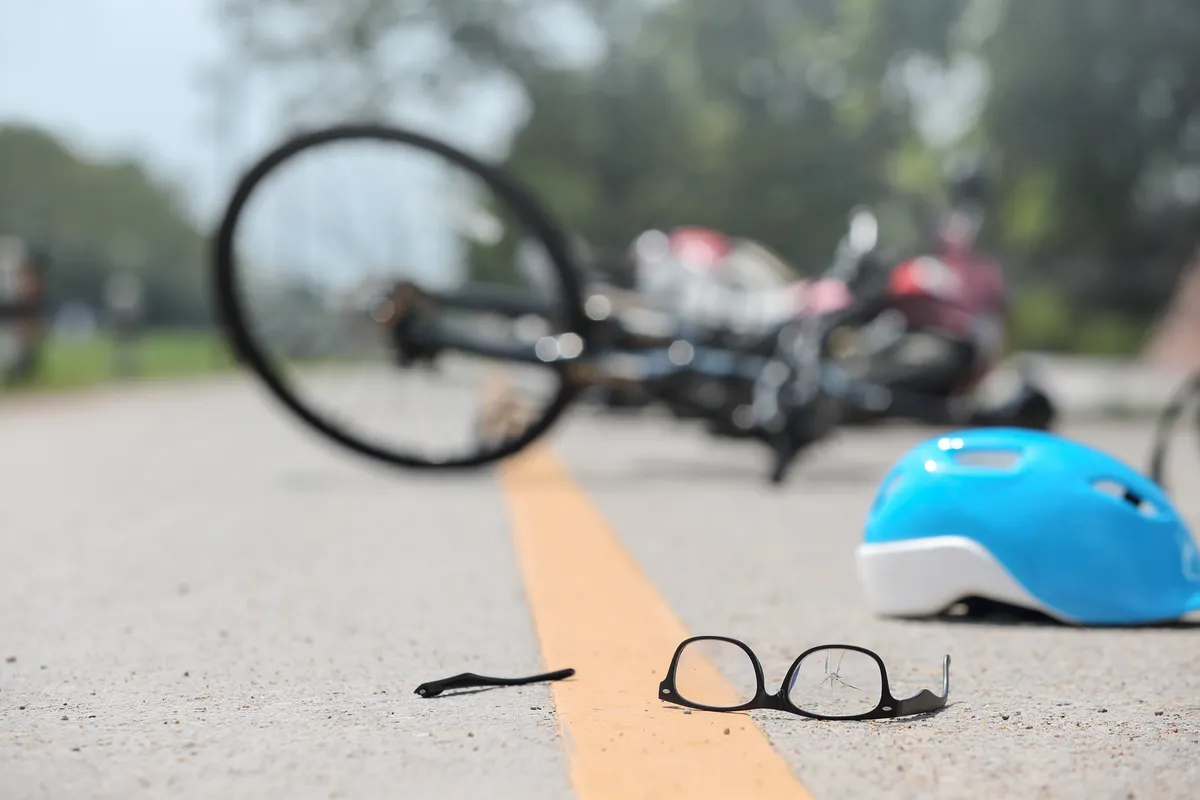
After hitting a cyclist, Nevada law under NRS 484E.010 requires drivers to stop immediately at the accident scene, render aid, and exchange information. Failing to do so can result in criminal charges, including hit-and-run felonies. Beyond stopping, drivers should take these steps:
- Call 911 immediately to report the bicycle accident
- Request emergency medical services, even if injuries appear minor
- File an official police report at the scene
- Document property damage and gather witness contacts
- Notify your insurance company promptly
Photographs of the road, vehicle positions, and visible injuries serve as valuable evidence for any future claim. The Nevada statute of limitations gives injured persons two years to seek compensation, making thorough documentation critical from the start.
Stop Your Vehicle and Remain at the Scene
NRS 484E.010 requires drivers involved in any accident resulting in injury or death to immediately stop their vehicle and remain at the scene. Leaving constitutes a hit-and-run, which carries serious consequences, including criminal charges, license suspension, and civil liability.
Nevada classifies fleeing the scene of an accident causing substantial bodily harm as a Category B felony, punishable by two to fifteen years in prison.
Check on the Cyclist's Condition and Call for Medical Help
After a collision, the cyclist's survival may depend on how quickly you act. Call 911 immediately. While waiting, avoid moving the cyclist if spinal injuries are suspected, since improper movement can worsen damage.
Document visible injuries carefully, as this detail directly impacts any future personal injury claim.
Contact Law Enforcement and Report the Accident
Under NRS 484E.070, drivers must immediately call law enforcement after any accident involving injuries, death, or property damage exceeding $750. Failing to report can escalate legal consequences. When officers arrive, they will document the scene, issue traffic citations, and file an official report, which directly supports any future insurance claims or legal proceedings.
Exchange Contact and Insurance Information With the Cyclist
NRS 484E.030 requires drivers involved in any accident to exchange contact and insurance information with all parties, including cyclists. This means providing your full name, address, vehicle registration, and insurance coverage details. Failing to do so can escalate civil liability and even lead to criminal charges.
The insurance company will need this information to process claims, so exchanging it accurately at the scene affects how smoothly the insurance claims process unfolds.
Document the Accident Scene Thoroughly
Photograph every angle of the bicycle accident, including skid marks, the cyclist's bike, and any visible injuries. Capture traffic flow patterns, road conditions, and vehicle positions. Useful documentation you should collect includes:
- Photos of property damage
- Witness contact details
- Traffic camera locations
- Insurance information exchanged
This evidence directly strengthens any personal injury claim filed afterward.
Notify Your Insurance Provider About the Incident
Contacting your insurance company promptly after hitting a cyclist is critical. Delaying this report can jeopardize your coverage as insurance companies typically have strict 24 to 72-hour reporting windows outlined in policy agreements.
Legal Consequences of Hitting a Cyclist With Your Car in Nevada
Hitting a cyclist with your car in Nevada can result in serious legal consequences on both criminal and civil fronts. Under NRS 484B.653, reckless driving carries penalties including fines up to $1,000 and potential jail time. If a cyclist dies as a result, drivers may face vehicular manslaughter charges under NRS 484B.657, which can escalate to a felony with up to 6 years in prison.
Beyond criminal charges, civil liability exposes the at-fault driver to a personal injury lawsuit where the cyclist can recover compensation for economic damages such as medical expenses, lost wages, and property damage. In rare cases involving extreme recklessness, courts may also award punitive damages, substantially increasing the financial burden placed on the driver.
Criminal Charges a Driver May Face in Nevada
Hitting a cyclist can result in serious criminal charges depending on the severity of the injuries involved. Under NRS 484B.653, drivers who exercise a willful or wanton disregard for safety around cyclists may face reckless driving charges. In more serious cases involving DUI or wrongful death, criminal charges can escalate to serious felony counts.
Traffic Citations and Fines Issued to Drivers
Nevada drivers who strike a cyclist can face traffic citations. For example, if a driver violates the three-foot space law outlined in NRS 484B.270, they could face a fine of up to $395, with additional penalties when the violation results in injuries. Also, failing to yield to a cyclist in a crosswalk carries a separate fine of up to $1,000 under Nevada law.
License Suspension or Revocation After a Cyclist Accident
Under Nevada law, drivers involved in bike accidents that result in serious injury or death can face license suspension or full revocation. NRS 483.460 outlines grounds for revocation, including reckless driving and hit-and-run offenses. For example, a hit-and-run involving a cyclist can carry penalties such as:
- Suspension periods of 13 years
- Mandatory DMV hearings
- Required SR22 insurance filing
Civil Liability for Injuries and Property Damage
Under Nevada law, drivers who hit a cyclist can face civil liability covering medical expenses, lost wages, and property damage. Nevada Revised Statutes Chapter 41 governs these personal injury claims, allowing injured cyclists to recover damages that sometimes exceed $100,000, depending on the severity of the injury.
What Happens If You Hit a Cyclist and Leave the Scene in Nevada

Leaving the scene after hitting a cyclist in Nevada results in serious legal consequences under NRS 484E.010, which requires drivers to immediately stop and remain at the scene of an accident. Failing to follow this law elevates the incident from a civil matter to a hit-and-run, which is classified as a Category B felony if the cyclist suffers substantial bodily harm, carrying 2 to 20 years in prison and fines up to $5,000.
Beyond criminal exposure, fleeing the scene severely damages any personal injury claim the at-fault driver might otherwise have negotiated down. Insurance companies can deny coverage entirely, leaving the driver personally liable for the cyclist's medical expenses, lost wages, and other economic damages tied to the bicycle accident case.
Hit-and-Run Laws and Penalties in Nevada
Under NRS 484E.010, drivers must immediately stop after striking a cyclist. Failing to do so carries serious consequences, as a hit-and-run involving injuries is a Category B felony, punishable by 2 to 20 years in prison and fines up to $5,000.
What to Do If You Have Already Left the Scene of the Accident
Returning to the scene immediately, even after the fact, can reduce your criminal exposure. Contacting law enforcement to report the accident voluntarily signals cooperation, which courts weigh favorably.
From there, it's recommended to set up a free case evaluation with the Las Vegas bicycle accident lawyers from The Rodney Okano Car Accident Lawyer Law Firm to better understand your legal options before making any statements to your insurance company.
Common Causes of Car-Cyclist Accidents in Nevada
Drivers failing to give cyclists the legally required three feet of clearance when passing is among the most common causes of bicycle accidents in Nevada. Other common causes of these accidents include:
- Dooring from parked cars
- Distracted driving at intersections
- Failure to yield on right turns
- Speeding in designated bike lanes
Injuries from these crashes range from traumatic brain injuries to spinal damage, often leaving cyclists with devastating medical expenses and lost wages.
Distracted Driving and Its Role in Cyclist Collisions
Distracted driving is a leading factor in car-cyclist collisions, with the NHTSA reporting that distracted drivers claimed 3,208 lives in 2024 alone. Cyclists are especially vulnerable because a driver glancing at a phone for just five seconds at 55 mph covers the length of a football field without watching the road.
Nevada drivers are prohibited under NRS 484B.165 from handheld device use while operating a vehicle, yet violations remain frequent.
Failure to Yield at Intersections
Failure to yield ranks among the most dangerous driver behaviors at intersections. Drivers must yield the right-of-way to cyclists traveling in bike lanes or roadways. When drivers ignore this obligation, cyclists are at risk for severe injuries.
The NHTSA reports that intersections account for roughly 38% of all bicycle accident fatalities nationally, making yielding violations a critical safety concern.
Dooring Incidents Near Parked Vehicles
Dooring happens when a parked driver or passenger swings open a car door directly into a cyclist's path. These dooring incidents can cause the cyclist to go flying off their bike and potentially into oncoming traffic.
Speeding and Reckless Driving Around Cyclists
Speeding reduces a driver's reaction time significantly, making collisions with cyclists far more likely. Drivers traveling even 10 mph over the speed limit double the crash-fatality risk for cyclists sharing the road.
NRS 484B.600 outlines that drivers must never operate a motor vehicle at a speed that is unreasonable or fast enough to endanger life or property, regardless of the posted speed limit. Failure to adhere to this law can result in fines up to $1,000.
Hazardous Areas Where Drivers Must Exercise Extra Caution
Certain road conditions dramatically increase the risk of a bicycle accident. Drivers must stay alert in:
- Intersections, where 38% of bicycle accidents occur
- School zones with posted speed limits
- Construction zones with narrow lanes
- Poorly lit roads at night
High-Risk Intersections for Cyclist Collisions
Intersections account for roughly 38% of all cyclist fatalities nationwide, with uncontrolled crossings and left-turn conflicts being the deadliest scenarios. Drivers making left turns frequently misjudge a cyclist's speed, cutting directly into their bike lane. High-traffic urban intersections, where vehicles and cyclists share compressed road space, increase these risks considerably.
Urban Streets With Heavy Bicycle Traffic
Downtown Las Vegas and the Fremont Street corridor see some of Nevada's highest cyclist-to-vehicle conflict rates. Due to the mix of pedestrians, cyclists, and other vehicles, drivers can get overwhelmed and commit a negligent act.
Rural Roads With Limited Visibility for Cyclists
Rural roads in Nevada often lack shoulders, bike lanes, and adequate lighting, creating dangerous blind spots for both drivers and cyclists. These areas can be especially deadly when the posted speed limit is 80 mph.
Areas Near Bike Lanes Where Conflicts Are Common
Intersections where bike lanes begin or end are among the most dangerous spots on the road, as drivers often fail to check for cyclists when merging.
Obtain the Compensation You're Entitled To
Contact Us Today
The Rodney Okano Car Accident Lawyer Law Firm is a Las Vegas personal injury law firm that specializes in representing those in car, truck, bus, and motorcycle accidents. Founded in 2001, our law firm has over 20 years of legal experience in Nevada and has remained dedicated to securing the maximum settlement for those injured in motor vehicle accidents. Our firm offers free consultations, which can be set up by calling or sending an email inquiry.