


8 min read time

Table of Contents

What Is Considered Street Racing Under Nevada Law
Under Nevada Revised Statutes 484B.653, illegal street racing is defined as any unauthorized speed contest or unauthorized trick driving display conducted on a public highway. This covers drag racing, acceleration contests, and timed speed runs between two or more motor vehicles. The law specifically targets racing that occurs outside sanctioned venues, meaning even a brief burst of competitive acceleration between drivers on a public road qualifies.
Notably, racing does not require exceeding the posted speed limit to meet the legal definition, since the competitive intent itself constitutes the violation. Law enforcement also recognizes exhibitions of speed involving a single vehicle as punishable conduct under Nevada law, broadening the statute's reach considerably.
Behaviors That Are Classified as Illegal Street Racing in Nevada
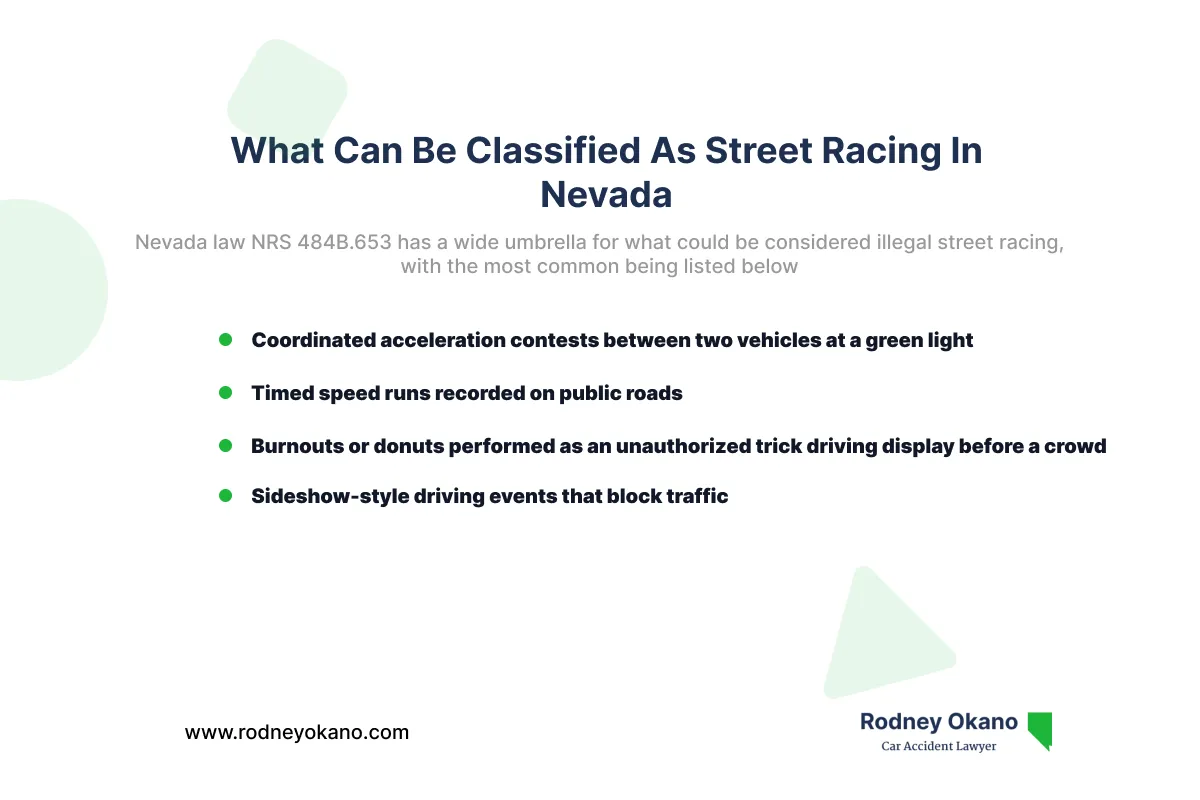
Beyond the examples outlined, Nevada law outlines several specific behaviors under the illegal street racing umbrella. These include:
- Coordinated acceleration contests between two vehicles at a green light
- Timed speed runs recorded on public roads
- Burnouts or donuts performed as an unauthorized trick driving display before a crowd
- Sideshow-style driving events that block traffic
Reckless driving behaviors tied to drag racing, such as weaving at high speeds, fall under NRS 484B.653 as well. Racing occurs the moment competitive intent is demonstrated, even without a formal start signal, as the central factor is the wanton disregard for public safety.
Criminal Penalties for Street Racing in Nevada
Under NRS 484B.653, a first-time street racing conviction is classified as a misdemeanor, carrying up to 6 months in county jail and fines reaching $1,000. However, drag racing offenses that result in serious injury or death escalate to a category B felony, which carries prison time ranging from 1 to 6 years.
Beyond incarceration, convicted drivers face license suspension for up to one year, mandatory community service, and significantly higher insurance premiums. When property damage occurs alongside the offense, courts may impose additional restitution penalties. Repeat offenders face enhanced sentencing under Nevada law, with each subsequent violation treated more severely than the last.
Misdemeanor Charges and Their Consequences for First-Time Offenders
A first-time street racing conviction carries a misdemeanor charge, punishable by up to 6 months in county jail and fines reaching $1,000. Beyond incarceration, Nevada courts can impose community service requirements alongside mandatory license suspension. The speed contest offense also adds demerit points to a driver's record, which results in insurance rate increases.
When Street Racing Escalates to a Felony Charge
Drag racing escalates to a category B felony when it causes severe injuries or death. A felony conviction carries 1 to 6 years in Nevada State Prison, along with fines up to $5,000. Unlike a misdemeanor street race charge, a felony stems directly from the harm caused, meaning the driver caused injury through an unauthorized speed contest on public roads.
Fines, Jail Time, and License Suspension Associated With Street Racing Convictions
A misdemeanor street racing conviction carries fines up to $1,000 and up to 6 months in county jail, though penalties intensify for repeat offenses. A second conviction can result in:
- Fines between $1,000 and $1,500
- Up to 6 months in county jail
- 100 - 199 hours of community service
- Mandatory license suspension for 6 months to 2 years
Nevada Statutes That Govern Street Racing and Related Offenses
Nevada handles street racing offenses under NRS 484B.653, which specifically criminalizes both drag racing and unauthorized speed contests on public roads. Beyond racing itself, the statute also covers an unauthorized trick driving display, which targets unofficial exhibitions of dangerous driving maneuvers.
Related offenses like running traffic signals fall under the same statute, though they carry distinct legal thresholds. Several key behaviors are prohibited under this law:
- Participating in or facilitating a speed contest
- Organizing a trick driving exhibition
- Racing near a school or work zone
- Causing property damage through racing conduct
Each violation carries its own penalty tier, with circumstances like location and resulting harm directly shaping the severity of charges filed.
NRS 484B.653 and Its Role in Defining Street Racing Offenses
Under NRS 484B.653, the legal definition of drag racing extends beyond two vehicles racing side by side. The statute captures a broad range of conduct, specifically targeting:
- Acceleration contests measured against time
- Speed competitions between two or more vehicles
- Driving at speeds that prevent safe stopping within a reasonable distance
An unauthorized speed contest doesn't require a formal starting line or crowd; even a spontaneous race between two drivers, or any action considered a willful disregard for others' safety, qualifies.
How Nevada Courts Interpret and Apply Street Racing Laws
Nevada courts evaluate street racing charges under NRS 484B.653 by examining specific circumstances surrounding each incident. Judges consider several key factors when applying the statute:
- Whether the conduct qualifies as a drag race, an unauthorized speed contest, or an unauthorized trick driving display
- The degree of property damage and injury caused
- Whether the driver lost control of the vehicle
- Prior criminal history of the defendant
Additionally, courts considered the evidence present; for example, a driver filmed participating in a street race may face stronger prosecution than someone charged solely on officer observation.
The Role of Aggravating Factors in Street Racing Criminal Cases
Aggravating factors can push a street racing charge from a misdemeanor into far more serious criminal territory. Under Nevada law, specific circumstances directly elevate the severity of prosecution, including:
- A prior record of reckless driving or racing offenses
- Racing in a school zone or heavily populated area
- Evidence of alcohol or drug impairment during the race
How Injuries or Deaths Elevate the Severity of Criminal Charges
When a street race results in injury or death, Nevada law escalates charges significantly beyond a standard misdemeanor. A racing incident that causes bodily harm can be prosecuted as a category B felony, carrying 1 to 6 years in prison. If the reckless driving or street race causes death, penalties increase further, with potential sentencing reaching up to 20 years.
A driver can also be:
- Held liable for property damage
- Charged under vehicular manslaughter statutes
- Pursued through a civil lawsuit by victims
The Rodney Okano Car Accident Lawyer Law Firm has handled many Las Vegas accident cases in which the at-fault driver faced serious penalties due to their reckless actions causing injury.
The Impact of Prior Convictions on Sentencing for Street Racing
Prior convictions tied to an unauthorized speed contest or reckless driving carry serious weight during sentencing. Under Nevada law, repeat offenders face mandatory minimum sentences that judges cannot reduce below statutory thresholds. A second conviction can result in:
- Potentially up to 6 months in jail
- Fines escalating from $1,000 to $1,500
- License suspension
- Vehicle impoundment
Civil Liability for Injuries Caused by Street Racing in Nevada
Beyond criminal penalties, street racing in Nevada opens the door to significant civil liability. Under Nevada tort laws, a victim injured in a reckless driving incident tied to an unauthorized speed contest can file a civil case seeking compensation for medical bills, lost wages, and property damage.
Nevada follows a modified comparative negligence rule under NRS 41.141, meaning a plaintiff can recover damages as long as they are less than 51% at fault. Spectators, organizers, and even vehicle owners who permitted the race can share liability. Damages awarded in these cases often reach six or seven figures, particularly when injuries are catastrophic or permanent.
Who Can Be Held Civilly Liable in a Street Racing Accident
Under Nevada law, civil liability in a street racing accident can extend well beyond the drivers involved. Parties who can face civil claims include:
- The racing drivers themselves
- Vehicle owners who knowingly allowed their car to be used in an unauthorized speed contest
- Event organizers who coordinated or promoted the race
- Property owners who permitted racing on their land
Organizers face particularly strong exposure under premises liability theory. Vehicle owners can be held liable under the Nevada negligent entrustment doctrine, which applies when an owner knowingly grants access to their vehicle to a reckless driver, making their financial responsibility concrete and enforceable.
Types of Damages Available to Victims of Street Racing Crashes
Victims of an unauthorized speed contest can pursue both economic and non-economic damages. Economic damages cover measurable losses like:
- Medical expenses
- Lost wages
- Property damage to the vehicle
Non-economic damages address:
- Pain and suffering
- Emotional distress
...which courts have awarded in substantial amounts given the egregious nature of reckless driving cases.
Punitive damages are also available when conduct is deemed especially malicious, which is common in street racing-related crashes, serving as financial punishment beyond standard compensation.
Common Injuries Sustained in Street Racing Accidents
Street racing accidents produce some of the most catastrophic injuries seen in any car accident scenario, due to how highly dangerous they are.
When drivers engaged in an unauthorized speed contest and lose control or collide with a vehicle at extreme speeds, the resulting collisions generate forces far beyond typical crashes. Victims commonly suffer:
- Traumatic brain injuries from violent impact
- Spinal cord damage leading to partial or full paralysis
- Compound fractures requiring multiple surgeries
- Severe burns from post-collision fires
- Internal organ damage from blunt force trauma
Street racing crashes occur at speeds frequently exceeding 100 mph, making survival itself remarkable. Bystanders and innocent motorists bear the worst outcomes, as these collisions often involve rollovers, multi-vehicle pileups, and structural intrusions into passenger compartments.
Due to the extent of injuries victims of street races can suffer, it's crucial to work with an experienced personal injury lawyer to ensure that your compensation is being maximized.
Traumatic Brain Injuries
Traumatic brain injuries (TBIs) are among the most devastating outcomes of an unauthorized speed contest. At extreme velocities, the brain violently shifts inside the skull upon impact, causing contusions, hemorrhaging, or diffuse axonal injury.
According to the CDC, TBI contributes to approximately 30% of all injury-related deaths in the U.S. Survivors frequently face permanent cognitive impairment, seizure disorders, and personality changes requiring lifelong medical intervention, often costing millions in cumulative care expenses that compound significantly over a victim's remaining lifespan.
Spinal Cord Damage
Spinal cord injuries rank among the most devastating consequences of reckless driving collisions. The severity of these injuries typically falls into two categories:
- Complete injuries, where all sensation and motor function below the injury site are lost
- Incomplete injuries, where partial function may remain
High-speed car accident impacts frequently cause complete cervical injuries, leaving victims permanently paralyzed and dependent on lifelong medical care.
Frequently Asked Questions
What Are the Criminal Penalties for Street Racing in Nevada?
Under Nevada Revised Statutes 484B.653, street racing is a misdemeanor for a first offense, carrying up to 6 months in jail and fines reaching $1,000. Penalties increase significantly when racing causes injury or death, potentially resulting in years of imprisonment.
Can Victims of Street Racing Accidents File a Civil Lawsuit in Nevada?
Yes, victims of street racing accidents can file a civil lawsuit in Nevada. Under Nevada Revised Statutes Chapter 41, injured parties may seek compensation for medical expenses, lost wages, and pain and suffering. Nevada follows a modified comparative negligence rule, meaning victims can recover damages as long as they are less than 51% at fault for the accident.
How Does Nevada Law Define Street Racing and What Activities Does It Cover?
Nevada Revised Statutes 484B.653 defines street racing as any acceleration contest, drag race, or speed competition on a public highway. The law covers organized races, time trials, and spontaneous challenges between drivers. It also includes "exhibition of speed," meaning reckless acceleration intended to impress onlookers, even without a competing vehicle present.
Obtain the Compensation You're Entitled To
Contact Us Today
The Rodney Okano Car Accident Lawyer Law Firm is a Las Vegas personal injury law firm that specializes in representing those in car, truck, bus, and motorcycle accidents. Founded in 2001, our law firm has over 20 years of legal experience in Nevada and has remained dedicated to securing the maximum settlement for those injured in motor vehicle accidents. Our firm offers free consultations, which can be set up by calling or sending an email inquiry.