

7 min read time

Table of Contents

Nevada Motorcycle Helmet Laws
Under Nevada Revised Statutes 486.231, motorcycle drivers and passengers must wear helmets that meet National Highway Traffic Safety Administration standards. Helmets must be worn at all times when operating the motorcycle and should be firmly attached at all times. If there is no transparent windscreen on the helmet or motorcycle, riders must use either:
- Goggles
- Glasses
- Face shields
Certified helmets need to be correctly sized and validated to reduce impact. Non-conforming or novelty helmets are prohibited. Offenses are classified as civil infractions, carrying fines ranging from $80 to $205 and two demerit points on the driver's license.
Who Is Required to Wear a Helmet on a Motorcycle
Under Nevada law, the following must wear helmets:
- Motorcycle drivers
- Motorcycle passengers
- Moped drivers and passengers
Helmets are mandatory for all riders, regardless of age or experience.
U.S. Department of Transportation Helmet Standards
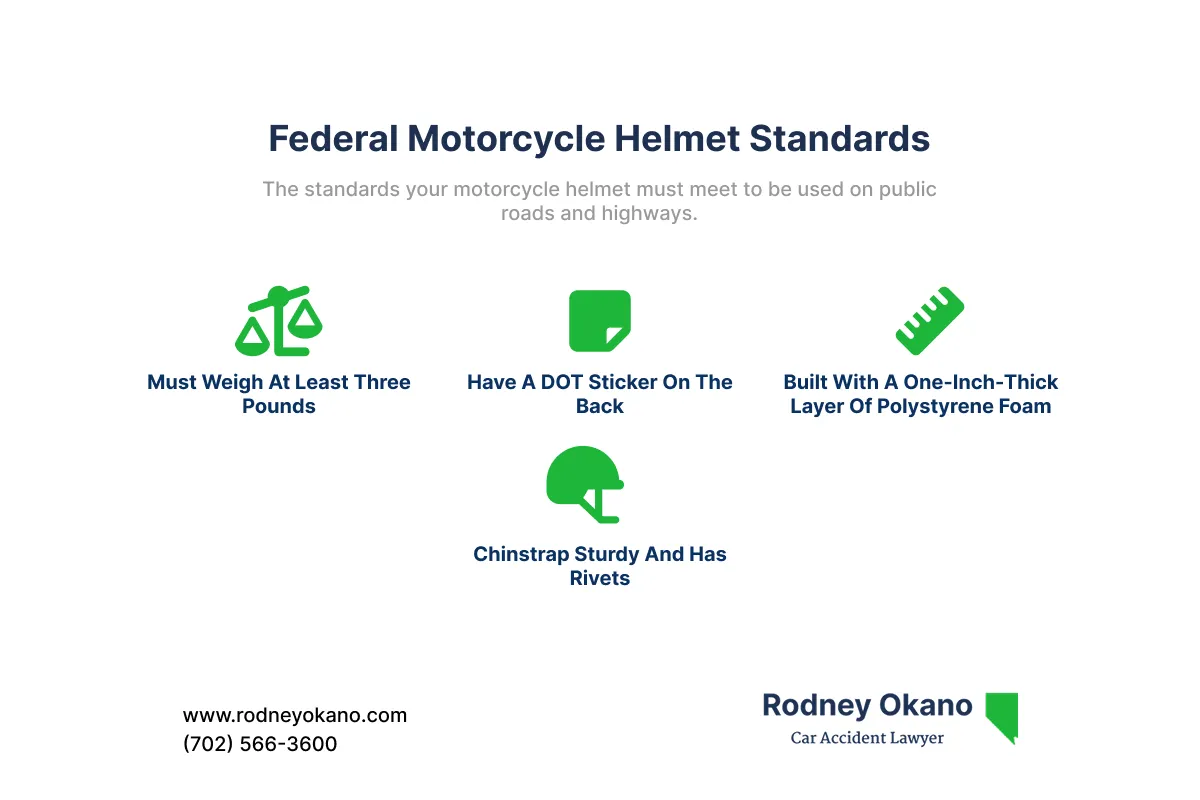
Nevada motorcycle helmet laws require helmets that meet the Federal Motor Vehicle Safety Standard No. 218. A legally compliant helmet must weigh at least three pounds, include a one-inch thick layer of firm polystyrene foam, have a chinstrap with rivets, and feature a DOT sticker on the back certifying compliance.
These standards are designed to ensure that helmets properly protect riders and passengers and reduce the risk of head injuries during a crash.
Do Motorcycle Helmet Laws Apply to All Riders in Nevada?
Motorcycle helmet laws in Nevada under NRS 486.231 require that all riders, including passengers, wear helmets on public roads.
The law applies without exception regardless of age or experience, and applies to everyone on public roads, whether they are Nevada residents or visitors from other states.
Failure to wear a motorcycle helmet can result in 2 demerit points and fines. Additionally, if you weren't wearing a helmet during a motorcycle accident, it could hurt your civil claim under Nevada modified comparative negligence laws.
Penalties for Riding Without a Motorcycle Helmet in Nevada
Violating Nevada's helmet requirement can have a range of consequences for riders. Fines vary by location, with Las Vegas typically citing around $195 to $205, while Reno cites a fine of $80. In addition, court fees may apply.
Beyond the financial penalties, a helmet violation adds 2 demerit points to your driving record. Accumulating 12 or more demerit points within a year can result in a six-month license suspension.
These points remain on your record for one year. A more subtle, but potentially worse, consequence is that helmet traffic violations can also increase insurance premiums, making it worthwhile to contest the citation to avoid these lasting effects on your record.
Fines and Citations for Helmet Violations
Under Nevada law, riding without a helmet is classified as a civil infraction, with penalties that differ by location:
- In Las Vegas, the fine ranges from $195 to $205
- In Reno, the penalty is $80
Each violation also adds two points to your driving record. Successfully completing traffic school or paying extra might help in reclassifying these charges as non-moving violations.
How Helmet Violations Appear on Your Driving Record
Helmet violations in Nevada are recorded on your DMV driving record, not your criminal record. A helmet violation adds two demerit points to your license, and these points remain for one year. Other information to note is:
- Points from a helmet violation accumulate with other traffic law violations
- Reaching 12 points within a year can lead to a six-month license suspension
- Civil infractions, including helmet violations, appear on DMV records for insurance companies to view and can only be sealed or removed by taking traffic school or paying extra.
Common Myths About Nevada Motorcycle Helmet Laws
Several myths circulate regarding Nevada motorcycle helmet laws. For instance, visitors from other states are not exempt from Nevada's helmet laws. Nevada's regulations apply to all riders within the state. Additionally, there is a misconception that passengers are not required to wear helmets.
However, Nevada law requires both drivers and passengers to wear helmets. Lastly, some people believe that only specific age groups are subject to the motorcycle helmet requirement, as it is for bicycles and e-bikes.
In truth, Nevada enforces a universal helmet requirement under NRS 486.231, meaning all motorcycle riders, regardless of age, must wear helmets.
Myth: Visitors From States Without Helmet Laws Are Exempt
Nevada's helmet laws, as stated in NRS 486.231, are applicable to all riders within the state, regardless of their origin. Being from a state without helmet requirements does not exempt individuals in Nevada.
Out-of-state visitors cannot use their state of residence as a legal defense.
Myth: Passengers Do Not Need to Wear Helmets
In Nevada, there is a common misconception that motorcycle passengers are not required to wear helmets. However, this is incorrect. As per NRS 486.231, both the driver and the passenger must comply with helmet requirements by wearing helmets that adhere to Federal Motor Vehicle Safety Standards (FMVSS).
Whether you are operating the motorcycle or merely a passenger, the law obliges you to wear a helmet when you are on public roadways.
Myth: Only Certain Age Groups Must Comply
Unlike e-bike or bicycle laws where only certain age groups have to wear a helmet, in Nevada, all motorcycle riders, whether the driver or a passenger and regardless of age, must wear helmets.
Nevada Bicycle Helmet Laws for Non-Electric Bikes
Nevada bicycle laws do not mandate helmets for cyclists on non-electric bikes. There are no statewide helmet requirements for any age group, but safety groups urge wearing helmets to reduce the risk of brain injuries. However, while state law doesn't have a bicycle helmet law, local ordinances differ:
- In Henderson, helmets are mandatory for riders under 18
- Boulder City mandates helmets for all riders under 18 using bicycles
These regulations change and can differ based on your location within Nevada.
Nevada E-Bike Classifications and Helmet Requirements
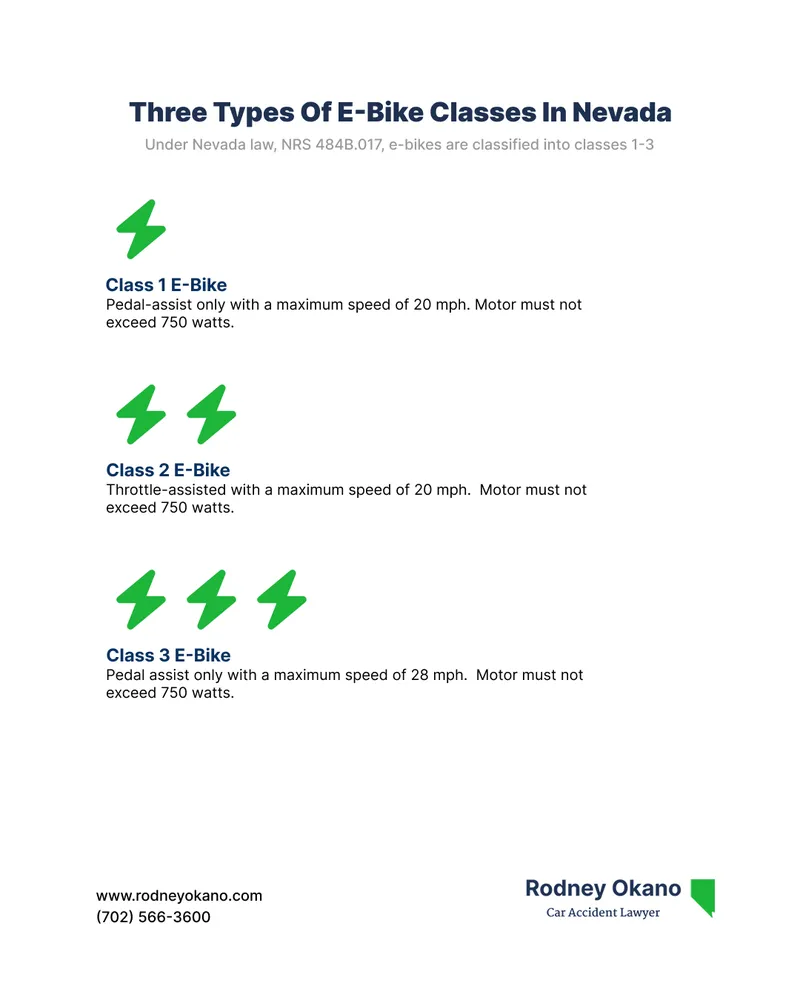
Nevada classifies e-bikes into three categories under NRS 484B.017. Class 1 e-bikes are pedal-assist only with a maximum speed of 20 mph, Class 2 e-bikes are throttle-assisted up to 20 mph, and Class 3 e-bikes are pedal-assist up to 28 mph. Nevada law does not enforce a statewide helmet requirement for any e-bike class or age group.
However, there are helmet requirements under local ordinances based on age. Clark County, Las Vegas, Henderson, and North Las Vegas require riders under 18 to wear helmets on e-bikes. Boulder City also mandates helmets for minors on bicycles, e-bikes, and electric scooters, with the ordinance taking effect on September 18, 2025.
To be safe and avoid fines, checking local rules in the area you plan to ride in is highly recommended.
Class 1, Class 2, and Class 3 E-Bike Definitions
Nevada law employs a graduated system to classify three e-bike classes under its electric bicycle laws:
- Class 1: Pedal-assist only, with a motor that stops at 20 mph.
- Class 2: Throttle-assisted, with a motor that also stops at 20 mph.
- Class 3: Pedal-assist only, with a motor that stops at 28 mph.
All classes mandate motors not exceeding 750 watts. These rules assist in identifying where riders can legally operate their e-bikes throughout Clark County and Las Vegas.
Nevada Moped Helmet Laws

Nevada law requires both drivers and passengers on mopeds to wear helmets approved by the U.S. Department of Transportation. Nevada law treats mopeds similarly to motorcycles, so they must meet the same helmet requirements. Riders must also wear protective eyewear if their moped lacks a transparent windscreen.
These rules apply whenever mopeds are operated on public roadways.
How Mopeds Differ From Motorcycles
Mopeds are different from motorcycles under Nevada law in several ways. NRS 486.038 defines a moped as having a small engine producing no more than 2 gross brake horsepower, a maximum output of 1,500 watts, and a top speed of 30 mph.
Also, motorcycles require a Class M license, while mopeds only need a standard Class C license. Due to the slow speeds of mopeds, they are not allowed on highways or freeways.
Helmet Requirements Specific to Moped Riders
Moped riders must wear helmets approved by the U.S. Department of Transportation. This requirement applies to both drivers and passengers, regardless of age, when on public roadways.
Under these rules, helmets must meet Federal Motor Vehicle Safety standards. Failure to comply can result in a fine and two demerit points.
Nevada E-Scooter Helmet Rules
NRS 484B.018 defines e-scooters in Nevada as vehicles that do not weigh more than 100 pounds, have a maximum speed of 20 mph when powered by an electric motor, are designed with handlebars, and are ridden in an upright or seated position.
Under NRS 484B.785, e-scooters are treated the same as a bicycle and electric bicycle, meaning adults are not required to wear helmets, but minors under 18 may be required to wear helmets under local regulations.
Also, rental e-scooter companies may require riders to be 16 or 18 and older to rent.
How Helmet Laws Differ Across Vehicle Types in Nevada
Helmet laws are different across vehicle types in these ways:
- Bicycle Helmet Laws: No state helmet requirement. Local rules may require riders under 18 to wear a helmet. Adults are exempt from helmet requirements under state and local laws.
- E-Bicycle and E-Scooter Helmet Laws: No state helmet requirement. Most local rules in Nevada require riders under 18 to wear a helmet. Adults are exempt from helmet requirements under state and local laws.
- Motorcycle and Moped Helmet Laws: State helmet requirement. All ages must wear a helmet while riding. Helmets must comply with federal standards.
Obtain the Compensation You're Entitled To
Contact Us Today
The Rodney Okano Car Accident Lawyer Law Firm is a Las Vegas personal injury law firm that specializes in representing those in car, truck, bus, and motorcycle accidents. Founded in 2001, our law firm has over 20 years of legal experience in Nevada and has remained dedicated to securing the maximum settlement for those injured in motor vehicle accidents. Our firm offers free consultations, which can be set up by calling or sending an email inquiry.